
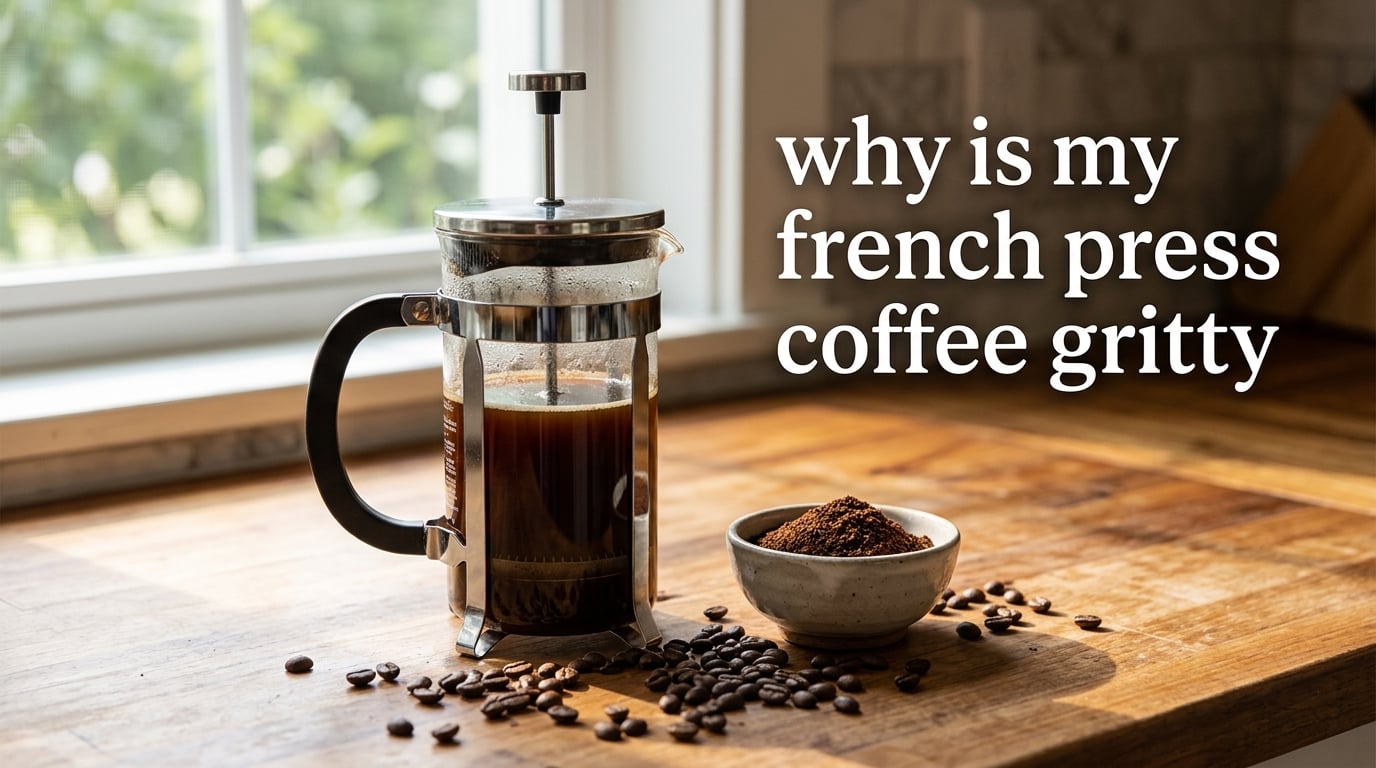
French press coffee is gritty when tiny particles called fines slip through the metal mesh filter. It happens most often because the grind is too fine, the plunger is pushed too fast, or the mesh filter is worn or damaged. A coarse, even grind and a slow, gentle plunge cut the grit by more than half.
I’ve brewed French press coffee almost every morning for years, and I still get sediment in my cup on the days I rush the process. The good news is that almost every grit problem has the same handful of causes – and the same handful of fixes. In this guide I’ll walk you through what’s actually happening in your carafe, the 5 most common culprits, and a 7-step routine you can use tomorrow morning to brew a noticeably cleaner cup.
Table of Contents
Why Is My French Press Coffee Gritty? The Short Answer
Your French press coffee is gritty because coffee fines – tiny particles produced during grinding – are slipping through the metal mesh filter along with the brewed coffee. A French press uses a metal mesh screen with holes typically 100 to 300 microns wide, which is much larger than the holes in a paper filter (around 15 microns). Any particles smaller than the mesh openings end up in your cup.
The four most common reasons this becomes a problem instead of a minor background texture are:
- Grind size is too fine (this causes about 70% of gritty cups)
- The plunger is pushed too fast or too hard, forcing trapped sediment through the mesh
- The mesh filter is bent, damaged, or has stretched holes
- The brew bed is over-stirred, suspending fines that would otherwise settle
Some sediment is completely normal with a French press. The goal isn’t a particle-free cup – it’s a cup where the texture is smooth and rich, not sandy or chalky.
Why French Press Coffee Always Has Some Sediment
The metal mesh filter is the defining feature of a French press, and it’s also the reason grit exists. Paper filters in drip or pour-over makers trap particles down to about 15 microns. A French press mesh, by contrast, has openings roughly 100 to 300 microns wide. That gap is wide enough to let through the smallest coffee particles – the fines – which is why even a perfect French press brew has a faint texture.
This is also why a French press produces a fuller-bodied, more oily cup than paper-filtered coffee: the mesh lets through oils and fine particles that paper would catch. The trade-off is intentional. If you want zero sediment, you’re really looking for a different brewing method.
The key insight is the difference between normal sediment and excess sediment. A cup with a faint, almost dusty layer at the very bottom is brewing correctly. A cup that turns cloudy in the first sip, or that has visible particles floating throughout, has a problem we can fix.
The 5 Main Causes of Gritty French Press Coffee
If your cup is more than faintly textured, one of these five causes is almost always responsible. They overlap, so you may need to fix more than one.
Cause 1: Your Grind Is Too Fine
This is the single most common cause. Fine grounds break apart into hundreds of small particles, and many of them are smaller than the mesh openings. Coarse grounds produce far fewer fines. If you buy pre-ground coffee labeled “French press” from a supermarket, it is often finer than it should be – supermarket grinders default to a setting closer to drip.
How fine is too fine? Anything that looks like table salt or finer will produce noticeable sediment. The sweet spot for French press looks like coarse sea salt – chunky, irregular, with visible flakes.
Cause 2: You’re Plunging Too Fast or Too Hard
The plunger is a filter, not a press. When you push down hard and fast, you force water through the mesh under pressure, and that pressure pushes trapped fines through the screen with it. A slow, gentle plunge – 20 to 30 seconds from top to bottom – lets the mesh do its job.
Plunging too hard also agitates the brew bed, kicking up sediment that has settled at the bottom of the carafe.
Cause 3: The Mesh Filter Is Damaged or Worn
French press filters don’t last forever. The mesh can stretch, tear, or develop tiny gaps over time. If you’ve had the same filter for a year or more and your brew has gotten grittier with no change to your technique, the filter is a likely culprit. Replacement mesh screens are inexpensive and available for most major brands.
You can test your filter by pouring clear water through it against a white background. If you see any particles in the water, the mesh has stretched.
Cause 4: You’re Over-Stirring the Brew Bed
Stirring during the brew is useful – it wets all the grounds evenly and helps extraction. But vigorous or repeated stirring suspends fines that would normally settle to the bottom of the carafe. A single gentle stir right after you pour the water (or right after the bloom) is plenty. Leave the brew alone for the rest of the steep.
Cause 5: Stale or Inconsistent Beans
Older beans crumble more during grinding, producing more fines than fresh beans. Beans also lose flavor and develop staleness once they’ve passed about three weeks off the roast date. If your beans have been sitting in the pantry for a month, both your sediment problem and your flavor problem will improve with a fresh bag.
A cheap blade grinder makes this worse. Blade grinders chop beans unevenly, producing a wide mix of boulder-sized chunks and powder-fine dust. The dust is what causes grit. Burr grinders crush beans to a uniform size, dramatically reducing fines.
Quick Reference: Issue, Cause, and Fix
This table maps the most common symptoms to their likely cause and the fastest fix. Use it as a starting point if you need to troubleshoot a specific problem.
| What You’re Seeing | Most Likely Cause | Fastest Fix |
|---|---|---|
| Visible particles throughout the cup | Grind too fine | Switch to a coarse, sea-salt-sized grind |
| Sludge or sediment at the bottom only | Plunged too fast | Slow the plunge to 20-30 seconds |
| Coffee is bitter and gritty together | Over-extracted fines | Coarsen the grind and shorten steep to 4 minutes |
| Grit has gotten worse over months | Worn mesh filter | Replace the filter screen |
| Cup is cloudy from the first sip | Over-stirred brew bed | Stir once after bloom, then leave it alone |
| Pre-ground coffee labeled “French press” | Supermarket grind too fine | Buy whole bean and grind at home |
How to Fix Gritty French Press Coffee: 7 Steps
These are the changes that will have the biggest impact. You don’t need to do all seven at once. Pick one or two, brew a pot, and see how it tastes before adding more.
Step 1: Switch to a Coarse Grind
This alone fixes about 70% of gritty cups. Aim for a grind that looks like coarse sea salt – chunky, irregular, with visible flakes. If you’re buying pre-ground, look for bags labeled “coarse” specifically, not just “French press.” If you’re grinding at home, dial your burr grinder two or three clicks coarser than your current setting and brew a test pot.
Step 2: Use a Burr Grinder Instead of a Blade Grinder
Burr grinders crush beans between two textured surfaces to a uniform size. Blade grinders chop with a spinning propeller, producing everything from boulders to powder in the same batch. The powder is your grit problem.
Entry-level burr grinders (like the Baratza Encore) start affordably and last for years. Hand grinders like the Comandante or 1Zpresso JX-Pro produce even fewer fines, but any burr grinder is a major upgrade over a blade grinder.
Step 3: Slow Your Plunge to 20-30 Seconds
Count it out. From the moment you start pressing until the plunger hits the bottom, it should take at least 20 seconds. A slow plunge lets water filter through the mesh gently rather than blasting trapped sediment through it. Apply light, even pressure – if you feel resistance, lift the plunger slightly and let it settle.
Step 4: Stir Gently Once, Then Leave It Alone
After you pour water over the grounds (or right after the bloom if you do a 30-second bloom), give the brew one gentle stir to wet any dry grounds floating on top. Then leave it alone for the full 4-minute steep. Repeated stirring suspends fines that would otherwise settle below the mesh.
Step 5: Let the Coffee Settle for 30 Seconds After Plunging
Once the plunger is fully down, wait another 30 seconds before pouring. The water just below the mesh is the most sediment-heavy. Letting it settle for half a minute gives the fines time to drift back down to the bottom of the carafe, away from your pour.
Step 6: Leave the Last 1-2 oz in the Carafe
This is the most popular tip on r/Coffee, and it works. The last ounce or two of coffee in the bottom of the French press is concentrated sediment. Stop pouring when you can see the level getting close to the mesh. Pour what’s left into the sink.
Step 7: Try the James Hoffmann Method or Double-Strain
If you’ve done steps 1-6 and still want cleaner coffee, two advanced techniques can help:
- James Hoffmann method: After 4 minutes of steeping, use a spoon to gently break the crust that has formed on top and skim it off before plunging. This removes the layer where fines concentrate.
- Double-strain: Pour the brewed coffee from the French press through a paper filter set in a second vessel. You get the body of a French press brew with the cleanliness of a paper filter. This is the most effective fix for sediment-sensitive drinkers.
The Best Grind Size for French Press (and How to Test Yours)
Visual comparison helps more than numbers. Here’s a quick reference for what your grind should look like compared to common kitchen textures:
| Texture | Particle Size | Use For |
|---|---|---|
| Table salt | Fine (~300 microns) | Espresso, AeroPress |
| Sand | Medium-fine (~500 microns) | Drip coffee, pour-over cone |
| Coarse sea salt | Coarse (~700-1000 microns) | French press (target) |
| Peppercorns | Extra coarse (~1000+ microns) | Cold brew |
The “finger test” is a quick way to check your grind without any tools. Rub a small amount of grounds between your fingers. If you can feel a lot of fine dust or powder, the grind is too fine. If the grounds feel uniformly gritty like sandpaper, you’re in the right zone.
If you’re grinding by feel for the first time, start two clicks coarser than you think you need. A slightly coarse French press brew tastes a little weaker but is much cleaner. You can always tighten the grind one notch at a time.
Advanced Tips: James Hoffmann Method, Double-Strain, and Paper Filters
Once your grind, plunger speed, and technique are dialed in, these last-resort options can take your French press closer to a pour-over in cleanliness without giving up the body.
The James Hoffmann Method
Barista and YouTuber James Hoffmann popularized a slightly modified French press routine that noticeably reduces sediment. The key step is breaking and skimming the crust before plunging:
- Brew normally with a coarse grind and 4-minute steep.
- At the 4-minute mark, use a large spoon to gently stir through the crust that has formed on the surface – the foam and floating fines concentrated there.
- Skim the broken crust and any floating grounds off the surface with the spoon.
- Wait 30 seconds, then plunge slowly.
Removing the crust takes away the layer where fines concentrate, which means less sediment in your cup. r/Coffee users consistently endorse this method.
Double-Strain Through a Paper Filter
For the cleanest possible French press cup, pour your brewed coffee through a paper filter into a second carafe or large pitcher. The paper catches everything the mesh missed, including the fines that produced the gritty texture.
You lose some of the oils and body that make French press unique, but you keep the deep, full flavor. This is a good option if you or someone you brew for is sensitive to sediment but doesn’t want to switch to drip.
Using a Paper Filter Insert
Some French press makers sell reusable paper filter inserts that fit inside the mesh. The mesh catches the bulk of the grounds, and the paper catches the fines. Cleanup is easier because the paper lifts out in one piece, and you can compost the grounds. This is the simplest long-term fix if you want French press body without the sediment.
When to Replace the Whole French Press
If your carafe has scratches on the glass, a loose-fitting plunger, or a warped frame, it’s worth replacing. A damaged carafe won’t hold heat properly, and a wobbly plunger won’t seal. Most replacement filters only fit specific brands, so if your model is discontinued, a new press is often the better value.
Frequently Asked Questions
Is French press sediment safe to drink?
Yes. The sediment in French press coffee is just ground coffee particles. They are not harmful, though they can taste bitter or chalky. If the texture bothers you, switch to a coarser grind or double-strain through a paper filter.
Should French press coffee be coarse?
Yes. French press should always be ground coarse – roughly the size of coarse sea salt. A finer grind produces more sediment and over-extracts quickly, leading to a bitter, gritty cup.
How long should you let coffee steep in a French press?
Steep French press coffee for 4 minutes. A shorter steep under-extracts and tastes weak. A longer steep over-extracts the fines and produces bitterness along with extra sediment.
What should French press coffee grind look like?
French press grind should look like coarse sea salt – chunky, irregular, with visible flakes. If it looks like table salt or finer, it is too fine and will produce a gritty cup.
Can you use a paper filter in a French press?
Yes. You can pour brewed French press coffee through a paper filter into a second vessel, or buy a French press with a built-in paper filter insert. Both methods catch the fines the mesh misses.
How often should I replace my French press filter?
Replace the mesh filter every 12 months, or sooner if you notice stretched holes, tears, or increasing sediment with no change in technique. Replacement screens are available for most major brands including Bodum and Frieling.
The Bottom Line
Most gritty French press coffee comes down to grind size – go coarse, ideally from a burr grinder. Slow your plunge, stir once, give it 30 seconds to settle, and leave the last ounce in the carafe. If you want even cleaner coffee, try the James Hoffmann skimming method or double-strain through a paper filter. One small change to your routine tomorrow morning will make a noticeable difference.