
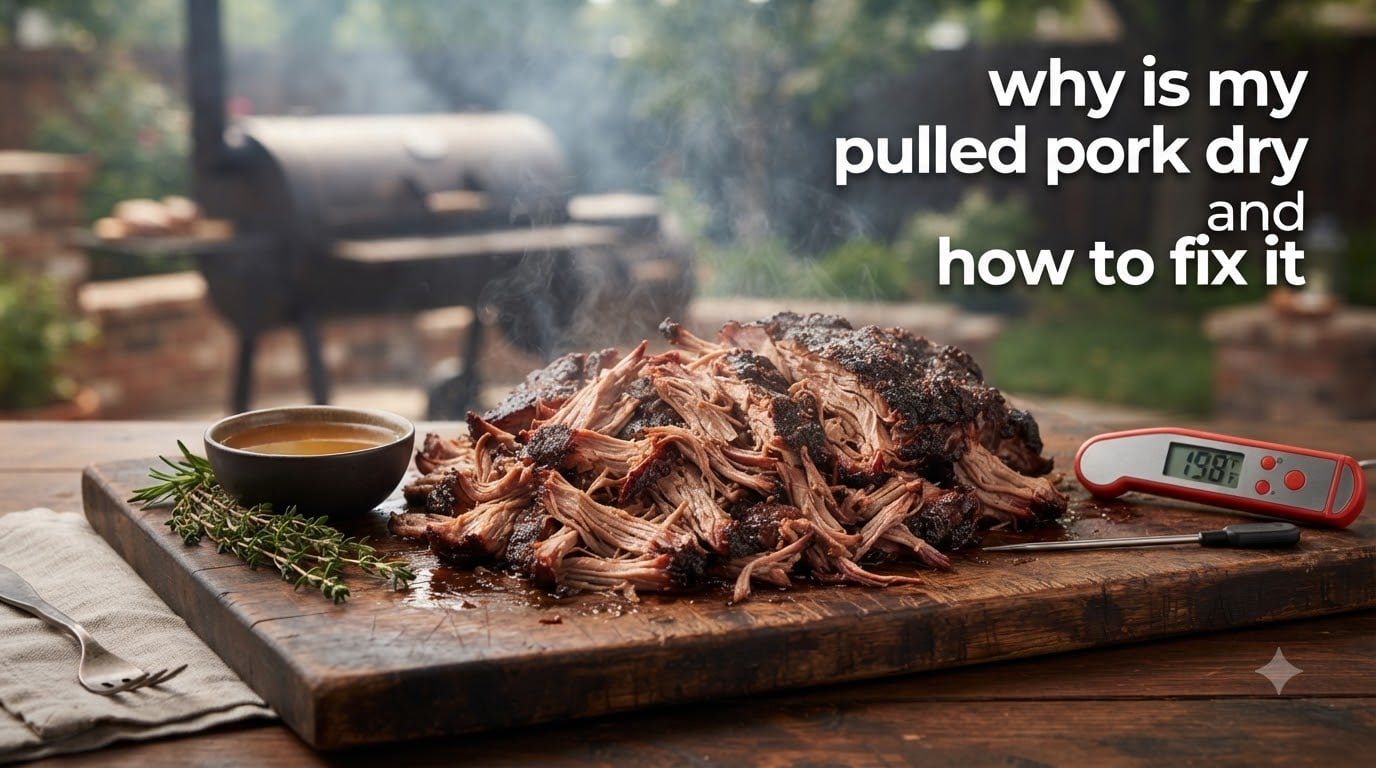
You pulled your pork butt off the smoker after 12 hours, eagerly shredded what looked like a beautiful piece of meat, and discovered it was bone-dry. It happens to nearly every pitmaster at some point, and the good news is dry pulled pork is fixable. Whether you cooked too hot, pulled it off too early, or skipped the rest, this guide walks you through exactly why pulled pork gets dry and how to rescue it.
I have been writing about BBQ and cooking for years, and pulled pork is one of those dishes that looks simple but hides real complexity underneath. A pork shoulder has to cook past the stall, hit an internal temperature of 203°F, rest long enough for juices to redistribute, and then get pulled at exactly the right moment. Skip any of those steps and you end up with meat that shreds but tastes like cardboard.
In this guide I will explain the seven most common reasons pulled pork turns out dry, walk you through the science of collagen breakdown, give you the exact temperatures and times you need, and most importantly, teach you how to fix already-dry pulled pork using a step-by-step rescue protocol that works every time. Whether you smoked it, slow cooked it, or used an Instant Pot, these techniques apply.
Table of Contents
Why Is My Pulled Pork Dry? 7 Main Causes Explained
Dry pulled pork almost always comes down to one of seven specific mistakes. Once you identify which one bit you, the fix becomes obvious. Let me walk through each cause so you can diagnose your situation.
Cause #1: You pulled it off too early. This is the number one reason for dry pulled pork. Most home cooks pull at 195°F or even 180°F, when the meat is technically “done” by FDA pork guidelines but nowhere near tender. The collagen has not finished breaking down into gelatin, so the meat shreds into dry, stringy chunks instead of juicy pieces that pull apart cleanly. Your target is 203°F internal, and I will explain why in detail below.
Cause #2: You cooked at too high a temperature. Cranking your smoker or oven to 300°F or higher pushes moisture out of the meat faster than fat can render. Low and slow at 225°F to 250°F keeps the internal temperature climbing gently so collagen has time to melt into gelatin without water evaporating through the bark.
Cause #3: You skipped or shortened the rest. Cutting into a pork shoulder right after pulling it from the heat is a guaranteed way to lose moisture. During the rest, juices that were driven toward the center during cooking redistribute back through the meat. Skip the rest and all that moisture runs onto your cutting board instead of staying in your pulled pork.
Cause #4: You did not use enough fat or moisture during cooking. A pork butt has plenty of internal fat, but leaner cuts like pork loin or a trimmed shoulder can absolutely turn out dry. Wrapping in foil with a splash of apple juice (the Texas crutch) or using a marinade injection keeps the meat from drying out during the long cook.
Cause #5: You overcooked it past 210°F. Yes, it is possible to go too far. Once internal temperatures climb past 210°F, muscle fibers begin to squeeze out their last drops of moisture, and the meat takes on a mushy, dry texture. Pull it at 203°F for best results.
Cause #6: You did not pull the meat, you chopped it. This sounds strange, but how you break down the meat affects perceived moisture. Chopping with a knife exposes more surface area, accelerating moisture loss. Pulling by hand (or with bear claws) keeps more moisture trapped inside larger shreds.
Cause #7: You are reheating it wrong. Many people only discover their pulled pork is dry when they reheat leftovers. Microwaving uncovered at full power blasts moisture out of the meat. Reheat gently with a splash of liquid and covered, and dry pulled pork becomes moist again.
The Science Behind Dry Pulled Pork: Collagen and Moisture Loss
Understanding why pulled pork gets dry starts with understanding what is happening inside the meat at a molecular level. Pork shoulder is one of the toughest cuts on the animal precisely because it does so much work during the pig’s life. That work builds dense connective tissue full of collagen, the same protein you find in tendons and ligaments.
Raw collagen is tough, rubbery, and essentially inedible. Heat transforms it. When the internal temperature of a pork shoulder climbs past 160°F, collagen begins shrinking and contracting, which is actually when the meat feels toughest. Push past 170°F and collagen starts converting into gelatin through hydrolysis. By the time you reach 203°F internal, most of the collagen has melted into a soft, water-binding gelatin that gives properly cooked pulled pork its characteristic silky, moist texture.
This is why temperature matters more than time. You can cook a pork shoulder for 24 hours at 225°F, but if you pull it at 180°F, the collagen never finished its conversion and the meat stays dry and tough. Conversely, a stall-breaking cook that reaches 203°F in 10 hours will produce more tender, moist pulled pork than a “low and slow” cook that stalls at 195°F.
Moisture loss works on a parallel track. Muscle fibers are like sponges filled with water. Heat causes proteins to denature and squeeze that water out. The faster and hotter you cook, the more water gets expelled before collagen has a chance to trap it as gelatin. This is the fundamental tension in pulled pork cooking: you need enough heat to convert collagen, but not so much heat that you squeeze all the moisture out first.
The stall compounds this problem. Around 150°F to 160°F internal, evaporative cooling on the surface of the meat pulls heat away faster than your cooker can deliver it, and the internal temperature stalls for hours. Many impatient cooks crank up the heat to power through the stall, which backfires because it dries the meat out before collagen finishes breaking down.
The solution is the Texas crutch: wrap the shoulder tightly in foil with a splash of apple juice or broth when you hit the stall. The foil traps moisture, powers through the stall, and lets collagen finish converting without drying out the meat.
What Temperature Should Pulled Pork Be? The 203°F Target
If you only remember one number from this entire guide, make it 203°F. That is the target internal temperature for pulled pork at which collagen has fully converted to gelatin and the meat shreds effortlessly while staying juicy.
Some pitmasters insist on 195°F, others swear by 207°F. Both can produce great results, but 203°F is the safe middle ground for most home cooks. At this temperature, the probe slides into the meat like a warm knife into butter. There should be almost no resistance. If you feel any tug at all, keep cooking.
Probe placement matters as much as the temperature reading itself. Insert your instant-read thermometer into the thickest part of the shoulder, avoiding bone, fat pockets, and the surface where it touched the heat. A leave-in probe is even better because you can track the climb in real time without opening the smoker and losing heat.
For timing, plan on 1.5 to 2 hours per pound at 225°F, though this varies widely with cooker type, weather, and whether you wrap. A typical 8-pound Boston butt takes 12 to 16 hours at 225°F. Plan accordingly and do not rush. Pulled pork rewards patience.
One more temperature tip: always check temperature in at least three spots. A single reading can fool you if you happen to hit a cold spot. If the lowest reading is 203°F, you are done. If one spot reads 195°F and another reads 205°F, you are somewhere in the middle and the meat may need another hour.
How to Fix Dry Pulled Pork: Step-by-Step Rescue Protocol
Your pulled pork is already dry. Now what? Do not throw it out. A good rescue protocol can turn dry pulled pork back into moist, enjoyable meat, even if it lost 20% of its original moisture. Here is the exact process I use when rescue duty calls.
Step 1: Chop the pulled pork into smaller pieces. Larger chunks hold less added moisture than finely chopped or shredded meat. Run your knife through the dry shreds and break them down into roughly 1-inch pieces. This dramatically increases surface area for the rescue liquid to penetrate.
Step 2: Warm a rescue liquid on the stove. You have options here, and the right choice depends on what flavor profile you want. My go-to is a 50/50 mix of apple juice and chicken broth, warmed gently with a tablespoon of butter per pound of meat. For competition-style results, use a mixture of beef broth, Worcestershire sauce, and a splash of pickle juice. For Carolina-style pulled pork, use a vinegar-based sauce instead of a sweet one.
Step 3: Add the liquid in small batches. Pour about 1/4 cup of warm liquid per pound of dry meat into a large pan or Dutch oven over low heat. Stir gently and let the meat absorb the liquid for 5 to 10 minutes. Do not drown the meat or you will end up with soup. You want moist, not soggy.
Step 4: Cover and rest for 15 minutes. Put a tight lid on the pan and let the meat sit off the heat for 15 minutes. This gives the gelatin and muscle fibers time to reabsorb the added moisture. Skipping this step means the moisture will run off onto the plate instead of staying in the meat.
Step 5: Taste and adjust. Now taste the rescued pork. If it still feels dry, repeat steps 3 and 4 with another splash of liquid. If it tastes good but lacks seasoning, add a dry rub or a splash of BBQ sauce. Many rescue operations end up tasting better than the original because you are layering flavors during the fix.
Step 6: Serve immediately or hold properly. Once your pulled pork is moist again, serve it right away, or hold it in a slow cooker on the “warm” setting with a little extra liquid at the bottom. This is the faux cambro technique used in competition BBQ: the meat stays above 140°F for hours without drying out.
This rescue protocol works for smoked, slow cooked, oven-baked, and Instant Pot pulled pork alike. It is also great for reviving leftover pulled pork that dried out in the fridge overnight.
Slow Cooker Pulled Pork Dry? Troubleshooting Different Cooking Methods
Slow cookers create dry pulled pork for a completely different reason than smokers do. Knowing which method you used changes how you fix the problem.
Slow cooker pulled pork goes dry because of evaporation over long cook times. A slow cooker runs at 200°F to 210°F with the lid on, which sounds moist, but condensation collects on the lid and drips back down. If the lid is not seated properly, or you lift it too many times to check on the meat, you lose steam. By hour 8, you may have lost a cup or more of liquid to evaporation.
The fix for slow cooker pulled pork is to add liquid at the start and never lift the lid during cooking. Start with at least 1/2 cup of broth or apple juice in the bottom of the crock. After 4 hours, the meat will have released its own juices, and you have a self-basting environment.
If your slow cooker pulled pork is already dry, the rescue steps above work perfectly. Slow cooker meat is usually more shredded than smoked meat, so it absorbs rescue liquid even faster.
Oven pulled pork has the same challenges as slow cookers, plus the bark dries out. If you cover the meat tightly with foil for the entire cook, oven pulled pork stays moist. If you leave it uncovered to develop a crust, the outside dries out while the inside stays juicy. Slice off the dried exterior and use the moist interior, or rescue the whole batch with the protocol above.
Instant Pot pulled pork rarely goes dry. Pressure cooking happens in a moisture-saturated environment, so the meat stays juicy by default. If your Instant Pot pulled pork came out dry, you probably cooked it too long or used too little liquid. Add 1 cup of broth next time and check at 90 minutes instead of going the full 120.
Smoked pulled pork is the most prone to dryness because of the long cook time, exposure to dry heat, and the stall. Wrapping in foil at the stall is the single most important technique for smoking moist pulled pork. I will cover that next.
How to Keep Pulled Pork Moist: Prevention for Next Time
Rescuing dry pulled pork works, but preventing the problem in the first place is even better. These are the techniques I use on every cook now, after learning the hard way with my own batch of shoe-leather pork shoulder.
1. Buy the right cut. Pork shoulder, also called pork butt or Boston butt, is the cut you want. It has the perfect ratio of fat to meat for pulled pork. Avoid pork loin, pork tenderloin, or anything labeled “lean” because they will be dry no matter what you do.
2. Trim, but leave the fat cap. Trim off the hard silver skin on the surface, but leave at least 1/4 inch of fat cap on top. As the shoulder cooks, that fat renders down through the meat and self-bastes it from the inside.
3. Inject for moisture insurance. A simple injection of apple juice, broth, and a little Worcestershire sauce adds moisture deep inside the meat where dry heat cannot reach it. Use a meat injector and distribute 1/2 cup to 1 cup of liquid evenly throughout the shoulder before cooking.
4. Dry brine overnight. Salt draws moisture to the surface and then reabsorbs it back into the meat, seasoning it from within. Coat the shoulder generously with kosher salt the night before, leave it uncovered in the fridge, and you will notice a real difference in juiciness and bark formation.
5. Wrap at the stall. Around 160°F internal, wrap the shoulder tightly in heavy-duty foil with a splash of apple juice or broth. This is the Texas crutch, and it is the single biggest moister-keeping technique in BBQ. The wrap powers through the stall in 30 minutes instead of 2 hours and traps every drop of moisture inside.
6. Cook to 203°F, no lower. Set your alarm for 203°F, not 195°F. Trust the thermometer, not the clock.
7. Rest for at least 1 hour. After pulling the shoulder off the heat, wrap it in a towel and place it in a dry cooler (the faux cambro method) for 1 to 4 hours. The meat stays hot, the juices redistribute, and pulling the pork becomes much easier.
8. Pull, don’t chop. Use bear claws or your hands (with food-safe gloves) to pull the meat apart along its natural grain. Chopping with a knife exposes too much surface area and accelerates moisture loss.
9. Hold with moisture. If you need to hold the pulled pork for more than 30 minutes before serving, place it in a slow cooker on warm with a little extra liquid at the bottom. Cover between servings.
Common Mistakes That Lead to Dry Pulled Pork
Here is a quick scan list of the most common errors that produce dry pulled pork. If you recognize yourself in any of these, you have found your culprit.
Cooking by time instead of temperature. Every shoulder is different. Time is a guideline. Temperature is the truth.
Pulling at 195°F. This is the single most common error. Pull at 203°F.
Lifting the lid every 30 minutes. Each lid opening adds 10 to 15 minutes to your cook and drives out steam. Trust the process and only open when you need to wrap or check temperature.
Skipping the rest. Cutting into a hot shoulder means juice runs out instead of staying in. Always rest at least 1 hour.
Not using a thermometer. Guessing doneness by feel or color is a recipe for dry pork. A $15 instant-read thermometer pays for itself the first time you use it.
Using lean cuts. Pork tenderloin and pork loin make terrible pulled pork. Stick with pork shoulder/butt.
Cooking at too high a temperature. Above 275°F and you are cooking roast pork, not pulled pork. Stay in the 225°F to 250°F range.
Forgetting to wrap. Unwrapped shoulders take 2 hours longer to get through the stall and lose more moisture. Wrap at 160°F.
Reheating in the microwave. The microwave nukes moisture out of leftover pulled pork. Reheat gently with liquid, covered.
Chopping instead of pulling. Chopped pulled pork dries out faster than hand-pulled. Pull by hand whenever possible.
Frequently Asked Questions
Why does pulled pork dry out?
Pulled pork dries out for a handful of common reasons: pulling it off the heat before the internal temperature hits 203°F, cooking at too high a temperature, skipping the rest period, or using a cut that is too lean like pork tenderloin. The 203°F target is critical because that is when collagen fully converts to gelatin, which is what gives pulled pork its moist, silky texture.
How do you fix dry pulled pork?
The fastest fix is to chop the dry meat into smaller pieces, warm a 50/50 mix of apple juice and chicken broth on the stove, add 1/4 cup of liquid per pound of meat, cover and rest for 15 minutes off the heat, then stir and taste. Repeat with more liquid if needed. The meat reabsorbs moisture during the rest and comes back to life.
What temperature should pulled pork be?
Pulled pork should reach an internal temperature of 203°F for the best balance of tenderness and moisture. At this temperature, collagen has fully converted to gelatin and the meat shreds effortlessly while staying juicy. Some pitmasters pull at 195°F to 207°F, but 203°F is the safest target for home cooks.
How long to smoke pulled pork at 225?
Plan on 1.5 to 2 hours per pound of pork shoulder at 225°F. An 8-pound Boston butt takes roughly 12 to 16 hours. Timing varies with weather, wind, and whether you wrap at the stall, so always rely on your thermometer instead of the clock.
Can you rescue overcooked pulled pork?
Yes, you can rescue overcooked pulled pork using the same liquid rehydration method as rescuing dry pulled pork. Chop the meat into small pieces, add warm broth or apple juice in small batches, cover and rest for 15 minutes, and repeat until the texture is moist again. The rescue works best when you catch it before the meat becomes mushy.
Why is my pulled pork tough?
Tough pulled pork usually means it was pulled off too early, before collagen finished converting to gelatin. Tough meat has not reached 203°F yet. Put it back on the smoker, in the oven, or back in the slow cooker with a splash of liquid and cook until the probe slides in without resistance.
How do you keep pulled pork moist in a slow cooker?
Add at least 1/2 cup of broth or apple juice to the bottom of the slow cooker before adding the pork, and never lift the lid during cooking. Cook on low for 8 to 10 hours until the internal temperature hits 203°F. If the lid fits loosely, drape a sheet of foil over the crock before putting the lid on to lock in steam.
Should I wrap pulled pork in foil?
Yes, wrap pulled pork in heavy-duty foil once the internal temperature reaches 160°F to power through the stall and lock in moisture. This technique is called the Texas crutch. The wrap shortens your cook time by 2 hours and keeps the meat significantly more moist than cooking unwrapped all the way to 203°F.
Final Thoughts on Fixing Dry Pulled Pork
Dry pulled pork is frustrating, but it is almost always fixable. The fastest rescue is warm apple juice and broth stirred into chopped meat, covered and rested for 15 minutes. The best prevention is cooking to 203°F internal, wrapping at the stall, and resting for at least an hour before pulling. Pulled pork rewards patience, and a few small technique changes will turn dry batches into juicy, pull-apart results every time you cook.