
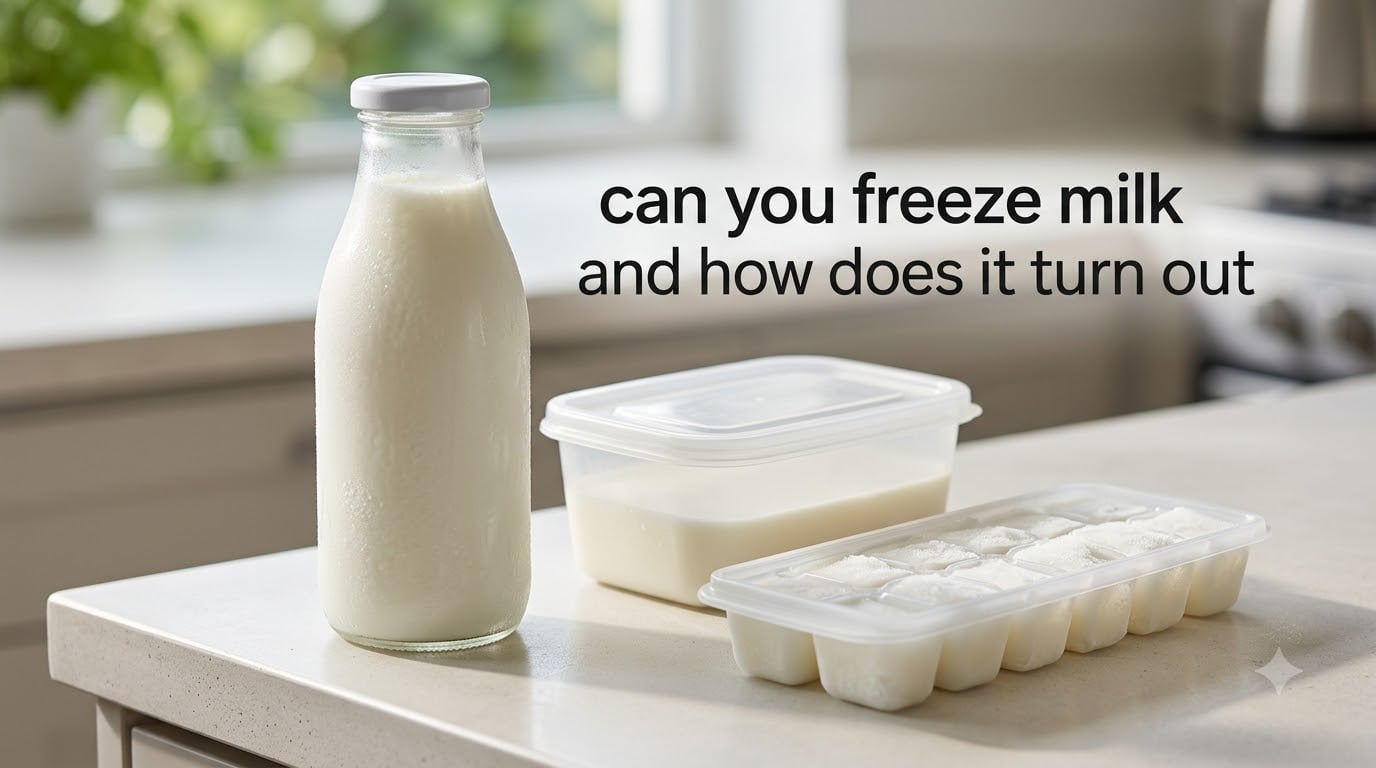
Yes, you can freeze milk. I have been freezing milk on and off for the better part of a decade, and it works every time when I follow a few simple rules. The short version: pour off about a cup to leave room for expansion, seal it in a freezer-safe container, label it with today’s date, and freeze for up to six months. When you need it, thaw it slowly in the fridge and give it a hard shake before you pour.
This guide walks you through exactly what I do, what actually happens to milk at freezer temperatures, why thawed milk sometimes looks grainy and won’t recombine, and how to fix that graininess for good. I will also cover different milk types (whole, skim, oat, almond, soy, coconut, and breast milk) and compare freezing milk to UHT and powdered milk so you can pick the method that saves the most money in your kitchen.
Table of Contents
Quick Answer: Can You Freeze Milk?
Yes, you can freeze almost any milk — dairy or plant-based. Most milk freezes well for 1 to 3 months, and stays safe to use for up to 6 months. The texture changes a bit when it thaws (fat separates, the liquid looks grainy or watery), but a vigorous shake or a quick blend brings it back close to fresh.
- Leave headroom. Pour off about 1 cup from a full half-gallon, or 2 inches from any container, because milk expands as it freezes.
- Use a freezer-safe container. BPA-free plastic jugs, hard-sided containers, or ice cube trays work. Avoid glass jars (they crack) and avoid freezing a full paper carton (it can split).
- Label with the date. Write today’s date on the container so you use the oldest one first.
- Freeze at the back of the freezer where the temperature is most stable.
- Thaw in the fridge overnight and shake well before using. Do not thaw at room temperature and never microwave.
How to Freeze Milk: Step-by-Step
Freezing milk the right way takes about 5 minutes of hands-on time. The trick is mostly about the container and the headroom. Here is the exact method I use, with the science behind each step.
Step 1: Pick the Right Container
The container matters more than people realize. A regular glass jar, even a mason jar, can crack from the expansion of freezing milk — I’ve lost a half-pint of whole milk to a shattered jar in my own freezer, and forum users on r/AskCulinary report the same thing. The safest options are:
- BPA-free plastic jugs or bottles with a little extra headroom.
- Hard-sided plastic containers made for the freezer (Tupperware-style).
- Heavy-duty freezer bags laid flat so they stack neatly.
- Ice cube trays for small portions you can drop straight into coffee or smoothies.
What doesn’t work: thin glass jars (cracking risk), the original paper or plastic carton if it’s completely full (it can split at the seam), and any container with a weak seal that lets in freezer odors.
Step 2: Leave Headroom for Expansion
Water expands about 9% when it freezes, and milk is mostly water. That expansion is why cartons burst and jars crack if you skip this step. For a half-gallon jug, pour off roughly 1 cup (about 8 oz) before freezing. For a quart container, leave about 1 to 1.5 inches of empty space at the top. For a freezer bag, do not fill it more than two-thirds full.
I learned this the hard way as a college student. I froze a sealed half-gallon and came back to a freezer that looked like a crime scene. Now I always leave the headroom, and I have never had a single container fail.
Step 3: Label, Date, and Freeze
Write today’s date on the container with a Sharpie or a piece of freezer tape. Frozen milk is safe for up to 6 months, but for the best flavor and texture, plan to use it within 1 to 3 months. Without a date, you will end up tossing perfectly good milk just because you can’t remember when you froze it.
Freezing milk does not magically extend the best-by date. If the milk is already 5 days past its sell-by date when you freeze it, the quality you freeze is the quality you thaw. Freeze the freshest milk you have for the best results.
Step 4: Store at the Back of the Freezer
The back of the freezer stays the coldest and the most consistent in temperature. The door is the warmest spot because it gets opened the most. Push your milk containers to the back and you will get a faster freeze, smaller ice crystals, and a smoother texture when you thaw.
What Happens to Milk When You Freeze It (The Science)
Milk is roughly 87% water, 4 to 5% fat, 3 to 4% protein, and about 5% lactose sugar. When it drops below 32°F (0°C), the water starts forming ice crystals, and the other components get squeezed into the shrinking liquid spaces. That is where the texture change comes from.
Two things happen at the same time:
- Ice crystals form. The water molecules slow down, lock into a crystal lattice, and grow. Fast freezing makes small crystals; slow freezing makes big crystals that tear apart the fat globules.
- The fat emulsion breaks. Fresh milk is homogenized, which means the fat is forced into tiny, evenly distributed droplets that stay suspended. Freezing and thawing disrupts that suspension, so the fat clumps together and the watery part separates out.
That is the science behind the slightly grainy, slightly yellow, sometimes watery look of thawed milk. It is not spoiled. The milk is perfectly safe — it just needs to be recombined.
How to Thaw Frozen Milk the Right Way
How you thaw frozen milk matters as much as how you freeze it. The slower you thaw, the smoother the texture when you are done.
Slow Thaw in the Fridge (Best Method)
Move the container from the freezer to the fridge the night before. A half-gallon usually needs 12 to 24 hours to thaw completely in the refrigerator. This slow thaw keeps the ice crystals small and gives the fat a chance to gradually re-mix into the liquid. When you pour it, give it a 30-second hard shake with the cap on tight, and it usually looks almost like fresh milk.
Cold Water Quick Thaw
If you forgot to plan ahead, set the sealed container in a bowl of cold water. Change the water every 30 minutes. A quart usually thaws in 1 to 2 hours this way. Do not use warm or hot water — heat causes the proteins to clump and you will get chunky milk no amount of shaking fixes.
What You Should Never Do
- Never microwave. Heat cooks the proteins and leaves you with a clumpy, unusable mess.
- Never thaw at room temperature. The outer layers warm into the danger zone (40 to 140°F) while the inside is still frozen, which invites bacterial growth.
- Never refreeze thawed milk. Once it has thawed, use it within 5 to 7 days. Refreezing compounds the emulsion damage and ruins the texture.
How Long Does Frozen Milk Last?
Here is the time breakdown I trust, combining US Dairy guidance, Cornell University dairy research, and my own freezer experiments:
- Best quality: 1 month. Flavor and color are nearly identical to fresh.
- Good quality: 1 to 3 months. Minor texture change, easily fixed with shaking.
- Still safe: 3 to 6 months. The milk is fine but the texture is noticeably off and freezer burn can creep in if the seal is imperfect.
- After thawing: 5 to 7 days in the fridge. Do not refreeze.
Freezing pauses bacterial growth but does not kill bacteria that were already there. That is why starting with the freshest milk you can find matters — you preserve the quality, you do not improve it.
Why Thawed Milk Stays Grainy (and How to Fix It)
This is the single biggest complaint I see on Reddit threads about freezing milk, especially in r/AskCulinary and r/foodhacks. Users freeze milk, thaw it in the fridge, shake it, sometimes even hit it with a milk frother, and it still looks like half water and half chunky curds. Here is what is actually happening, and how to actually fix it.
The fat globules and the milk proteins (mostly casein) form a network during freezing. When the milk thaws, that network does not automatically dissolve. A simple shake redistributes the fat, but it does not break the protein clumps. That is why your frother and your shaking arm lose.
Three fixes that actually work:
- Blend it. A 10-second pulse in a countertop blender or with an immersion blender breaks the protein clumps and re-emulsifies the fat. This is the fix reviewers on r/AskCulinary confirm works.
- Add a pinch of salt or a splash of lemon juice before blending. The acidity helps the proteins re-dissolve into the liquid. Use this batch for baking or cooking, not drinking straight.
- Use it for cooking or baking right away. Pancake batter, béchamel, mashed potatoes, scrambled eggs, and soup do not care about texture. The graininess disappears once the milk is heated and stirred.
If your thawed milk still won’t recombine after a blender pulse, that usually means it was frozen very slowly or sat too long past its best-by date before you froze it. Use it for baking rather than cereal.
Best Uses for Thawed Milk
Thawed milk is not ideal for a tall frosty glass alongside cookies — the texture, even when fixed, is not quite the same as fresh. But it shines in any application where it gets heated, blended, or mixed into other ingredients. Here are the recipes I reach for first:
- Pancakes, waffles, and muffins. The graininess disappears into the batter, and you cannot tell the difference from fresh.
- Béchamel and cream sauces. Heat and stirring fully re-emulsify the milk. Use it for mac and cheese, lasagna, or gravy.
- Mashed potatoes. Hot potatoes plus a warm milk-and-butter mixture is one of the most forgiving uses there is.
- Smoothies. Freeze the milk as ice cubes and you skip the dilution problem. Drop a few cubes straight into the blender with fruit.
- Soup and chowder bases. Corn chowder, potato soup, cream of mushroom — all of them are perfect hiding spots for thawed milk.
- Iced coffee and espresso drinks. Milk ice cubes keep your drink cold without watering it down.
The general rule: if the milk is going to be heated, blended, or mixed into something, thawed milk is indistinguishable from fresh. If you are pouring it straight into a bowl of cereal or a glass, fresh is better.
Freezing Different Types of Milk
Most milks freeze, but the results vary. Here is what to expect for each type.
Whole Milk and Skim Milk
Both freeze well. Whole milk has more fat, so the texture change after thawing is a little more visible. Skim milk has almost no fat to separate, so thawed skim looks closer to fresh — but it also gets grainy faster because the proteins are more concentrated. For both, shake well after thawing.
Oat, Almond, Soy, and Coconut Milk
Plant-based milks freeze, but the results depend on the brand and the additives. Oat milk freezes the best of the plant milks because of its natural starch content, which acts as a stabilizer. Almond milk freezes fine but often separates and looks gritty when thawed — a quick blend fixes it. Soy milk has enough protein to hold together well, and a shake is usually enough. Coconut milk freezes beautifully; just leave headroom and thaw slowly. Avoid freezing flavored or sweetened plant milks if you can — the sugar and flavoring can crystallize and change the taste.
Breast Milk
Breast milk freezes very well, and the CDC recommends freezing it if you are not going to use it within 4 days of expression. Use BPA-free plastic bottles or breast milk storage bags specifically designed for the freezer. Leave about an inch of headroom, label with the date, and store at the back of the freezer. Breast milk keeps for 6 to 12 months in a deep freezer, 3 to 6 months in a regular freezer. Thaw in the fridge or under cool running water, and use within 24 hours of thawing. Do not refreeze.
Shelf-Stable UHT and Powdered Milk
UHT (ultra-high temperature processed) milk is already shelf-stable without freezing — that is its whole point. Powdered milk keeps for years in a sealed container at room temperature. If your goal is backup milk, UHT cartons in the pantry and powdered milk in the cupboard are easier than freezing. The trade-off is taste and cost; both can have a slightly different flavor than fresh milk.
Frozen Milk vs UHT vs Powdered: Which Saves More?
For frugal shoppers, freezing milk is one of three common ways to stock up without waste. Here is how they compare:
| Method | Shelf Life | Cost | Taste vs Fresh | Best Use |
|---|---|---|---|---|
| Frozen fresh milk | 1 to 6 months | Same as fresh (you need a freezer) | Very close when thawed well | Drinking, cooking, baking |
| UHT (shelf-stable) | 6 to 12 months unopened | Slightly higher per ounce | Slight cooked-milk note | Backup supply, coffee, cereal |
| Powdered milk | 1 to 2 years sealed | Lowest per ounce | Noticeably different when mixed | Baking, emergency supply, coffee creamer |
If you have freezer space and you use milk regularly, freezing milk is the cheapest option because you can buy the larger, lower-unit-price container and freeze the excess. If you want a true backup that does not need a freezer, UHT cartons are the cleanest swap. Powdered milk wins for long-term emergency storage but loses for everyday cooking because of the taste difference.
Frequently Asked Questions
Is milk still good after it freezes?
Yes. Milk that has been frozen and properly thawed is safe to drink and use in cooking. Freezing pauses bacterial growth rather than killing bacteria, so the milk you freeze should be as fresh as possible. Thawed milk keeps for 5 to 7 days in the fridge and should not be refrozen. The flavor and texture may be slightly different from fresh, but the nutrition is essentially the same.
What milk can you not freeze?
Almost every milk can be frozen, but a few are poor candidates. Carbonated milk drinks lose their fizz and taste flat. Flavored or heavily sweetened plant milks can crystallize during freezing. Some ultra-filtered high-protein milks stay grainy even after blending. And very low-fat dairy milks can develop a mealy texture because the proteins clump without enough fat to buffer them. For best results, freeze plain whole or 2% dairy milk, plain oat milk, plain soy milk, or full-fat canned coconut milk.
Can I freeze milk in plastic bottles?
Yes, plastic bottles work well for freezing milk as long as they are BPA-free and freezer-rated. Leave at least 1 to 2 inches of headroom at the top because milk expands roughly 9% when it freezes. Avoid thin water bottles or single-use disposable plastic that can crack at freezer temperatures. Hard-sided reusable plastic bottles or the original milk jug (after pouring off about a cup to leave room) are your safest choices.
Why does milk not freeze well?
Milk does freeze, but it does not freeze into a smooth solid the way water does. When milk freezes, the water forms ice crystals and the fat separates out of its homogenized emulsion, so the thawed milk looks grainy, watery, or slightly yellow. The proteins (mainly casein) also clump together during freezing. Shaking, blending, or heating the thawed milk re-emulsifies most of that, but the texture will rarely be identical to fresh milk.
The Bottom Line
You can absolutely freeze milk, and it is one of the easiest ways to stop wasting milk you cannot finish before it goes bad. The keys are leaving headroom, using a freezer-safe container, labeling with the date, and thawing slowly in the fridge. If your thawed milk comes out grainy, a quick blend or heating it for a recipe brings it right back. Freezing milk is safe, frugal, and a great fit for anyone who buys in bulk or wants a backup supply on hand.
Start small: pour off a cup from your next half-gallon, freeze it in a hard plastic container, and use it next week in pancakes or coffee. Once you see how well it works, you will wonder why you were not doing it years ago.