
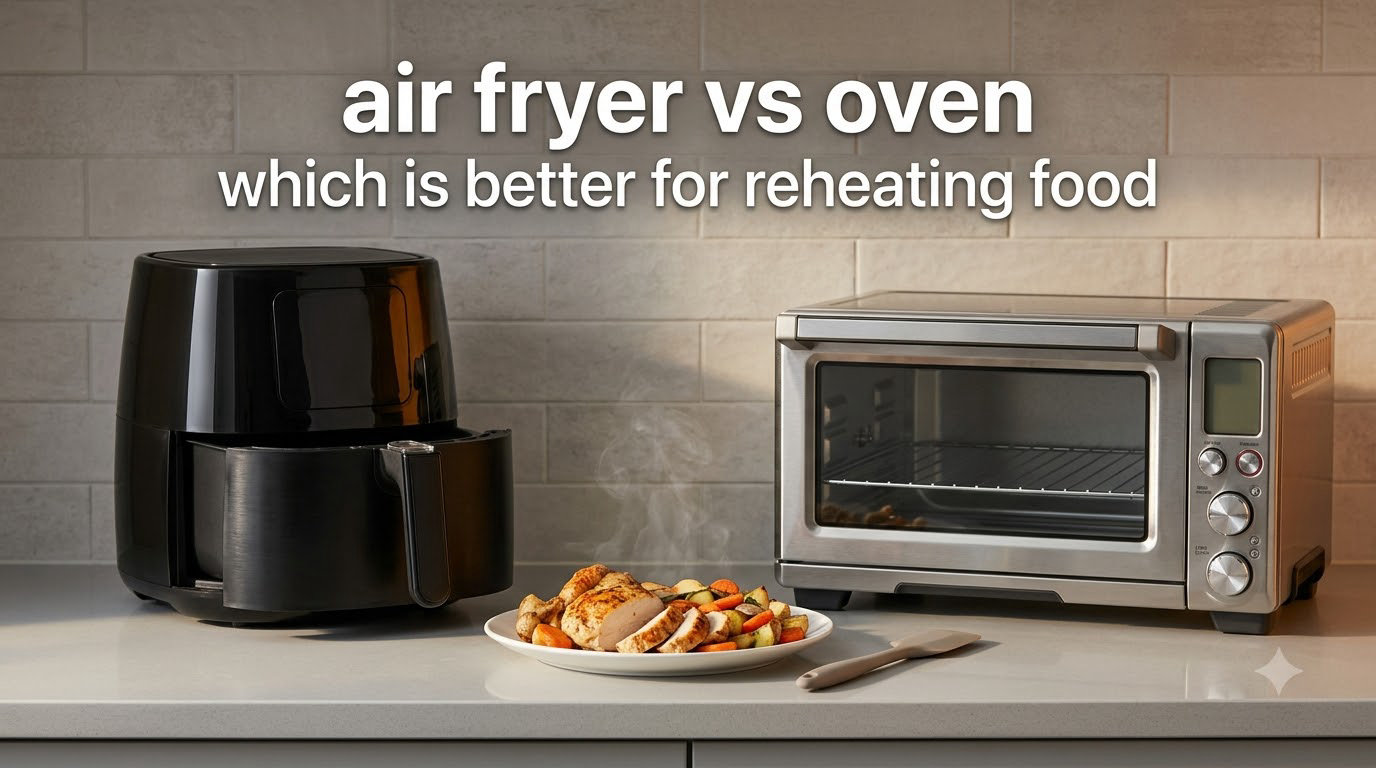
If you have ever pulled a slice of pizza from the microwave and found a sad, rubbery square, you already know why the air fryer vs oven reheating food debate matters. Both appliances can rescue leftovers, but they do it in completely different ways, and choosing the wrong one can ruin a perfectly good meal. I have been testing reheating methods in my own kitchen for years, and the short answer is this: an air fryer wins for crispy foods and small portions, while a conventional oven wins for large batches, delicate items, and saucy dishes. The longer answer, with temperatures, timing, and the science behind the crunch, is below.
In this guide I will walk you through how each appliance actually works, give you a side-by-side comparison table, share food-specific reheating instructions, and answer the most common questions home cooks ask on Reddit and cooking forums. By the end, you will know exactly which appliance to reach for when you open the fridge.
Table of Contents
How Does an Air Fryer Reheat Food?
An air fryer is a compact countertop appliance that reheats food using rapid air circulation. A heating element warms the air inside a small chamber, and a high-speed fan pushes that hot air around the food from every angle. Because the chamber is small and the air moves fast, heat reaches the surface in under three minutes and starts pulling moisture out of the outer layer.
That moisture removal is the secret to the air fryer’s signature crunch. When surface water evaporates, the temperature on the outside of the food climbs high enough to trigger the Maillard reaction, the same browning process that gives fresh-baked bread its golden crust and roasted chicken its color. In practical terms, this is why a slice of pizza reheated in an air fryer comes out with a crispy crust and bubbling cheese, instead of the limp result a microwave produces.
The compact cooking chamber is also why air fryers preheat so quickly. Most models reach 375°F in about two to three minutes, compared to 10 to 15 minutes for a full-size oven. That speed matters when you are reheating a quick lunch or a late-night snack.
The Limits of Air Fryer Reheating
Because the chamber is small and the fan is aggressive, air fryers have a few weaknesses. Saucy foods like lasagna, curry, or soup tend to dry out on the edges before the center warms through. Anything with loose batter or wet coating can fly around or stick to the basket. And the small basket limits you to reheating two to four portions at a time, which is why families often default to the oven instead.
How Does an Oven Reheat Food?
An oven reheats food using radiant heat from heating elements at the top, bottom, or both. In a conventional oven, heat rises from the bottom element and creates a gentle, even warmth throughout the cavity. In a convection oven, an extra fan circulates that hot air, which speeds cooking and improves browning.
The oven’s main advantage is its size. A full-size oven can hold a full sheet pan, a casserole dish, or multiple plates of leftovers at once. Heat reaches food more gently because the cavity is larger and the air moves more slowly, which means delicate items like baked fish, custard, or bread rolls reheat without drying out.
The trade-off is time. A conventional oven needs 10 to 15 minutes to preheat, and reheating usually takes 15 to 25 minutes. For one slice of pizza or two chicken tenders, that is a lot of wasted energy. Convection ovens are faster, but still slower than an air fryer for the same portion.
Air Fryer vs Oven: Side-by-Side Comparison
Below is a direct comparison of how each appliance performs on the factors that matter most when reheating leftovers. I tested the same foods in both appliances over several weeks to build this table.
| Factor | Air Fryer | Oven (Conventional) | Oven (Convection) |
|---|---|---|---|
| Heat Method | Rapid hot air circulation | Radiant heat from elements | Radiant heat + fan |
| Preheat Time | 2-3 minutes | 10-15 minutes | 6-10 minutes |
| Best Texture Result | Crispy exterior | Even, gentle warmth | Crispy with even interior |
| Capacity | 2-4 portions | 6-12 portions | 6-12 portions |
| Energy per Session | 0.3-0.5 kWh | 2.0-3.0 kWh | 1.5-2.5 kWh |
| Cleanup | Non-stick basket, dishwasher safe | Rack and sheet pan | Rack and sheet pan |
| Counter Space | Takes up counter or shelf space | Built in | Built in |
| Best For | Pizza, fries, wings, breaded items | Casseroles, large meals, baked goods | Roasts, multiple trays, pastry |
| Worst For | Saucy dishes, soups, liquids | Single portions, quick snacks | Single portions, quick snacks |
The biggest takeaway: pick the air fryer when crispiness matters, and pick the oven when portion size or gentleness matters.
Air Fryer vs Oven: Temperature and Timing Guidelines
One of the most common questions I see is whether 400°F in an air fryer is the same as 400°F in an oven. The short answer is no. Because the air fryer’s fan moves hot air so quickly, food cooks about 20 to 25 percent faster at the same temperature. A good rule of thumb is to drop the air fryer temperature by 25°F compared to the oven recipe, then check for doneness a few minutes early.
Here is a quick conversion chart for the most common reheating tasks:
| Food | Oven Temp | Oven Time | Air Fryer Temp | Air Fryer Time |
|---|---|---|---|---|
| Pizza slice | 375°F | 8-10 min | 350°F | 3-4 min |
| French fries | 400°F | 8-12 min | 375°F | 4-6 min |
| Chicken wings | 375°F | 15-20 min | 350°F | 6-8 min |
| Bread rolls | 350°F | 6-8 min | 325°F | 3-4 min |
| Casserole | 350°F | 20-30 min | Not recommended | Not recommended |
| Roasted vegetables | 400°F | 10-12 min | 375°F | 5-7 min |
| Fried chicken | 375°F | 12-15 min | 350°F | 6-8 min |
Always preheat the air fryer for 2 to 3 minutes before adding food, and shake the basket halfway through for fries and wings so they reheat evenly. For the oven, place food on a wire rack over a sheet pan if you want airflow underneath, which helps bottom crusts stay crisp.
Food-Specific Reheating Guide: What Works Best in Each
Different foods behave differently in each appliance. Below is a food-by-food guide based on my own kitchen tests and the most-upvoted advice from the r/airfryer and r/Cooking communities.
Reheating Pizza
The air fryer is the clear winner here. Set it to 350°F and heat a slice for 3 to 4 minutes. The crust comes out crispy, the cheese melts evenly, and you avoid the soggy bottom you get from a microwave. The oven works too, but it takes 8 to 10 minutes for the same result and uses far more energy.
Reheating French Fries
An air fryer brings day-old fries back to life. Set it to 375°F and cook for 4 to 6 minutes, shaking the basket halfway through. The fries come out crispy on the outside and warm in the center. An oven can do this at 400°F for 8 to 12 minutes, but I find the texture is usually drier and less consistent.
Reheating Chicken Wings
For wings, the air fryer is hard to beat. Set it to 350°F and heat for 6 to 8 minutes, flipping halfway. The skin re-crisps without overcooking the meat. In the oven, use 375°F for 15 to 20 minutes and place the wings on a wire rack so air circulates underneath. Both work, but the air fryer is faster and produces crispier skin.
Reheating Bread, Rolls, and Pastries
Bread dries out fast in any appliance, so the air fryer is best because of the short cooking time. Use 325°F for 3 to 4 minutes. For croissants or buttery pastries, wrap them in foil first to prevent the outside from burning. In the oven, 350°F for 6 to 8 minutes wrapped in foil works well, but again, takes longer.
Reheating Casseroles and Lasagna
For saucy, layered dishes, the oven is the better choice. Cover the dish with foil and heat at 350°F for 20 to 30 minutes until the center reaches 165°F. Remove the foil for the last 5 minutes if you want a browned top. Air fryers struggle here because the sauce drips through the basket and the small chamber cannot fit a full casserole dish.
Reheating Roasted Vegetables
Both appliances work well for vegetables, but the air fryer is faster. Use 375°F for 5 to 7 minutes and shake the basket halfway. In the oven, use 400°F for 10 to 12 minutes. Either way, avoid overcrowding the basket or pan, or you will end up with steamed vegetables instead of roasted ones.
Reheating Saucy Foods, Soups, and Curries
Skip both appliances and use the stovetop. Sauces splatter in an air fryer and dry out in an oven. Reheat soups and curries in a pot over medium-low heat, stirring often, until everything is hot and bubbly.
When to Use the Air Fryer vs the Oven
Here is a simple decision guide. Use the air fryer when you are reheating one to four portions of crispy food, you want it done in under 10 minutes, or you care about energy savings. Use the oven when you are reheating a full family meal, working with saucy or delicate foods, or want to reheat multiple dishes at once.
Another way to think about it: the air fryer is best for solo lunches and quick snacks, while the oven is best for dinner reruns and Sunday meal prep. If you cook for one or two people most nights, the air fryer will probably handle 80 percent of your reheating. If you cook for a family of four or more, the oven will still be your workhorse.
Pros and Cons of Air Fryer and Oven Reheating
Here is a quick summary of where each appliance shines and where it falls short.
Air Fryer Pros
- Fast preheat and cook time
- Excellent crispy texture
- Uses less electricity per session
- Compact and easy to store
- Easy to clean, often dishwasher safe
Air Fryer Cons
- Small capacity limits batch reheating
- Not suitable for saucy or liquid foods
- Can burn food if you forget to lower the temperature
- Takes up counter space
Oven Pros
- Handles large batches and full meals
- Gentle, even reheating for delicate foods
- Built into most kitchens, no counter space needed
- Versatile for casseroles, roasts, and baked goods
Oven Cons
- Slow preheat, especially conventional models
- Uses more energy per session
- Can dry out food if overheated
- Longer cleanup for racks and pans
Energy Efficiency: Which Costs Less to Run?
An air fryer uses roughly 0.3 to 0.5 kWh per reheating session, while a conventional oven uses 2.0 to 3.0 kWh for the same job. That is about five to eight times more energy for the oven. If you reheat leftovers once a day, switching to the air fryer for small portions can noticeably lower your electricity bill over a year.
That said, if you are reheating a full casserole or a sheet pan of food, the oven is more efficient per portion because the air fryer would need multiple rounds. Convection ovens sit in the middle, using 1.5 to 2.5 kWh per session while still giving you better browning than a conventional model.
Health Considerations When Reheating Food
Both appliances are healthier than a microwave for most foods, because they do not use radiation and they do not change the molecular structure of the food. The main health concern with reheating is acrylamide, a compound that forms when starchy foods are cooked at high temperatures. Air fryers actually produce less acrylamide than deep fryers because they use little to no oil, but they can still create some browning on bread, potatoes, and other starchy leftovers.
To minimize acrylamide while still getting a crispy result, keep the temperature below 400°F, avoid charring, and store leftovers properly in the fridge so they reheat evenly. Using a small amount of oil, brushing it on lightly, can also help food crisp up at a lower temperature.
Frequently Asked Questions
Is reheating in an air fryer better than a microwave?
Yes, for most foods. An air fryer restores a crispy exterior and warm interior, while a microwave tends to make food soggy or rubbery. The trade-off is time: an air fryer takes 3 to 8 minutes, while a microwave takes 1 to 2 minutes. For foods where texture does not matter, like soup or steamed vegetables, the microwave is still faster and easier.
Is 400 degrees in an air fryer the same as 400 degrees in an oven?
No. Because the air fryer uses rapid air circulation in a small chamber, it cooks food about 20 to 25 percent faster than an oven at the same temperature. As a rule of thumb, set the air fryer 25°F lower than the oven recipe and check a few minutes early to avoid burning.
What are the disadvantages of using an air fryer for reheating?
The main disadvantages are small capacity, which limits batch reheating, poor performance with saucy or liquid foods, and a higher risk of burning if you do not lower the temperature compared to oven recipes. Air fryers also take up counter space and usually need to be cleaned by hand or in a small dishwasher rack.
Can an air fryer completely replace an oven for reheating leftovers?
Not entirely. An air fryer can replace an oven for most single-serving or small-batch reheating, especially crispy foods like pizza, fries, and chicken. But it cannot handle a full casserole, a large roast, or saucy dishes like lasagna or curry. For families or those who reheat large meals, an oven is still essential.
Is an air fryer a healthier way to cook than an oven?
Both are healthier than deep frying because they require little to no oil. Air fryers may produce slightly less acrylamide than conventional ovens for starchy foods because they cook faster and at slightly lower effective temperatures. The biggest health factor is what you reheat and how you store it, not which appliance you use.
Which uses less electricity, an air fryer or an oven?
An air fryer uses about 0.3 to 0.5 kWh per reheating session, compared to 2.0 to 3.0 kWh for a conventional oven. That makes the air fryer roughly five to eight times more energy efficient for small portions. For full meals, the gap narrows because the oven can do the whole job in one round.
Final Verdict: Air Fryer or Oven for Reheating?
When it comes to the air fryer vs oven reheating food debate, there is no single winner. The best appliance depends on what you are reheating, how much, and how fast you need it. For solo meals, crispy leftovers like pizza, fries, and wings, the air fryer wins on speed, texture, and energy use. For family-sized portions, casseroles, baked goods, and saucy dishes, the oven still does the job better.
My honest recommendation: use both. Reach for the air fryer for weekday lunches and quick snacks, and save the oven for Sunday meal prep and dinner reruns. With the temperature and timing guidelines above, you will get perfect results from either appliance, every time.