
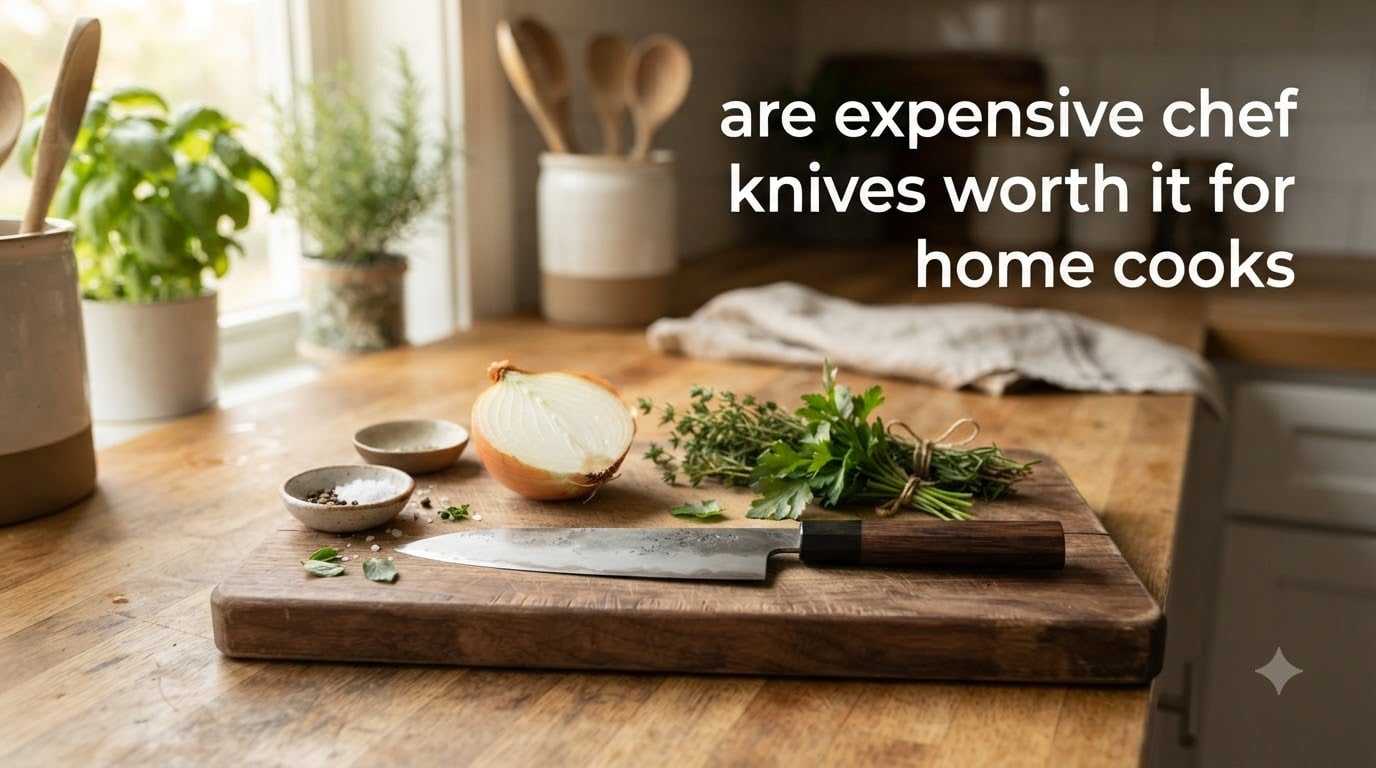
Expensive chef knives are worth it for home cooks who prepare meals three or more times per week, because the higher upfront cost delivers better steel, longer edge retention, less wrist fatigue, and a knife that lasts decades. For occasional cooks, a quality mid-range blade under $100 covers 90% of what most people need. The honest answer depends on how often you cook, not on the price tag alone.
I sharpened knives at a small cookware shop for two years before I started writing about them. The single biggest lesson from that job was this: the $30 chef’s knife and the $300 chef’s knife are both capable tools, just built for different hands and different kitchens. Let me walk you through the actual differences so you can decide for yourself.
Table of Contents
What Makes a Chef Knife Expensive
An expensive chef’s knife earns its price through three things: better steel, better construction, and better handle design. Once you understand those three levers, the price gap between a $40 knife and a $300 knife stops feeling mysterious.
Steel Quality and HRC Hardness Ratings
The biggest cost driver is the steel. Budget knives use softer stainless steel (around 52-55 HRC on the Rockwell hardness scale) that dulls in a week or two. Premium knives use high-carbon stainless steel hardened to 58-62 HRC, which holds a working edge for months.
HRC measures how hard the steel is. Harder steel takes a sharper edge and keeps it longer, but it’s also more brittle and harder to resharpen. The sweet spot for a home cook is 58-60 HRC. VG-10, AUS-10, and SG2 are common premium steels you’ll see on mid-to-high-end blades. Damascus steel refers to a layered construction technique that often (but not always) signals a premium knife.
Edge retention is the practical payoff. A $40 knife might need honing every other cooking session. A $200 knife stays sharp enough for clean tomato slices through a full week of dinners.
Forged vs Stamped Blade Construction
Forged knives are made by heating a single piece of steel and hammering it into shape. This aligns the grain of the steel, makes the blade tougher, and typically produces a denser, better-balanced knife. Stamped knives are cut from a sheet of steel, like a cookie cutter.
Most kitchen knives under $50 are stamped, and most over $150 are forged. Stamped blades work fine for light home use, but forged blades hold up better to years of daily prep work and resist chipping when you hit a hard butternut squash skin or a chicken bone.
Full Tang vs Partial Tang Design
A full tang knife has a single piece of steel that runs from the tip of the blade all the way through the handle. A partial tang (or rat-tail tang) has a narrow metal stem that extends into the handle but doesn’t fill it. Full tang construction is stronger, better balanced, and easier to repair if the handle ever cracks.
You can usually spot a full tang by looking at the top, bottom, or back of the handle. If you see the steel running through as a solid piece, it’s full tang. If the handle is one continuous material (plastic or wood) with no visible metal, it’s partial tang.
Cheap vs Expensive Chef Knives: The Honest Comparison
Here’s how a budget, mid-range, and premium chef’s knife actually stack up when you put them side by side.
| Feature | Budget (Under $50) | Mid-Range ($100-200) | Premium ($200-400) |
|---|---|---|---|
| Steel hardness | 52-55 HRC | 56-59 HRC | 60-62 HRC |
| Construction | Stamped | Forged or stamped | Forged, often layered |
| Tang | Partial or rat-tail | Full tang | Full tang |
| Edge retention | 1-2 weeks | 1-2 months | 2-6 months |
| Resharpening | Easy, but needed often | Easy to moderate | Moderate (needs whetstone) |
| Balance | Often handle-heavy | Centered or blade-forward | Custom-tuned per knife |
| Typical lifespan | 2-5 years | 10-20 years | 20+ years, often lifetime |
| Best for | Occasional cooks, renters | Most home cooks | Daily cooks, enthusiasts |
The biggest jump in real-world performance happens between budget and mid-range. Beyond $200, you’re paying for steel refinement, handle ergonomics, and craftsmanship that matters most to people who cook every single day.
When an Expensive Chef Knife Is Worth It for Home Cooks
Expensive knives pay off when you actually use them. Here are the scenarios where I’d tell a home cook to invest.
You cook most days of the week. Three or more home-cooked meals per week adds up fast. A knife that stays sharp for two months instead of two weeks saves real time and frustration.
You prep large volumes. Sunday batch cooking, meal prep for the week, or cooking for a family means dozens of cuts per session. A sharp, well-balanced knife reduces fatigue noticeably.
You have wrist, hand, or joint issues. Better knives require less force per cut. Reviewers with arthritis or carpal tunnel frequently report that a lighter, sharper blade lets them cook without pain.
Safety is a real concern. This one surprises people, but dull knives cause more cuts than sharp ones. You press harder, the blade slips, you bleed. A knife that holds its edge is genuinely safer to use.
You cook for a living (or want to). Even home cooks who take their craft seriously notice the difference. A knife that glides through an onion instead of crushing it changes how cooking feels.
When a Cheap Chef Knife Is the Smarter Choice
Expensive knives are not the right answer for everyone. Here’s when a budget knife wins.
You cook once or twice a week. If dinner is mostly takeout, leftovers, or a quick pasta, you won’t notice the difference between a $40 knife and a $300 knife. Save your money.
You’re renting or moving often. Cheap knives are easier to replace if they walk off in a move or get damaged by a landlord. No emotional attachment, no financial loss.
You don’t sharpen anything. A premium knife that’s never sharpened is a wasted investment. It will perform worse than a maintained budget knife within six months.
You’re buying a knife set. Block sets of 8-20 knives are almost always a bad deal. You use three knives 90% of the time: an 8-inch chef’s knife, a paring knife, and a bread knife. Spend the set money on one excellent chef’s knife instead.
You’re still learning your grip and cutting style. Wait until you’ve cooked for six months before committing serious money. Your preferences (Japanese vs German, light vs heavy) will become clearer with experience.
How Much Should You Spend on a Chef Knife
For most home cooks, the sweet spot is $100 to $200. That range gets you a forged, full-tang knife with steel hard enough to hold an edge for weeks or months. Below $100, you start compromising on construction. Above $200, the improvements matter mostly to daily cooks and enthusiasts.
The Victorinox Fibrox 8-inch chef’s knife is the classic recommendation in this range. It’s around $50, uses stainless steel that’s easy to maintain, and outperforms many knives costing three times as much for everyday prep. Most professional cooks I know own one, even if they have more expensive blades.
If you want to step up, brands like Tojiro, MAC, and entry-level Wusthof or Henckels sit in the $100-180 range. Japanese makers like Shun start around $150 for a basic gyuto (their version of a chef’s knife). Premium makers like Miyabi, Misono, and global knives sit in the $200-400 range.
Here’s the cost-per-year math that changes how people think about expensive knives. A $300 knife that lasts 30 years costs you $10 per year of ownership. A $40 knife you replace every three years costs you $13 per year, and you never get the better cutting experience. Premium knives are often cheaper in the long run, especially if you sharpen them instead of replacing them.
Japanese vs German Knives for Home Cooks
Japanese and German knives take different approaches to the same job. Neither is objectively better; they suit different hands and cutting styles.
German knives (Wusthof, Henckels) are heavier, with a curved belly that’s built for a rocking cut. They tend to be more durable, easier to maintain, and forgiving for beginners. The steel is usually a bit softer, which means easier resharpening.
Japanese knives (Shun, Global, MAC, Misono) are lighter, thinner, and harder. The straighter edge favors a push-cut or slicing technique. They hold an edge much longer but chip more easily and require whetstone sharpening rather than a pull-through sharpener.
If you grew up cooking with a Western-style knife and use a rocking motion, German is the natural fit. If you want precision, lighter weight, and you don’t mind learning basic whetstone sharpening, Japanese is worth exploring. Many home cooks end up owning one of each.
How to Get the Most Out of a Good Knife
An expensive knife is only as good as the care you give it. These habits make any knife perform better and last longer.
Hone regularly, sharpen occasionally. Honing with a honing steel realigns the edge every few uses. Sharpening actually removes metal and is needed a few times per year. Both matter; they’re not the same thing.
Use a wooden or plastic cutting board. Glass, stone, and marble boards dull knife edges fast. A good wood or high-density plastic board protects your edge.
Hand wash and dry immediately. Dishwasher heat, harsh detergent, and contact with other utensils damage handles and edges. A 30-second hand wash extends knife life by years.
Store it properly. A knife block, magnetic strip, or in-drawer organizer keeps the edge from knocking against other tools. Loose drawer storage is the most common cause of chipped blades.
Learn basic whetstone sharpening. For Japanese knives and any premium blade, a whetstone is the right tool. It looks intimidating and takes an hour to learn. Once you’ve done it a few times, it’s faster than a pull-through sharpener and produces much better results.
Reddit’s r/Cooking and r/BuyItForLife communities both emphasize this point: maintenance matters more than price. A neglected $300 knife performs worse than a maintained $50 knife, every time.
Frequently Asked Questions
Are expensive chef knives worth it?
Expensive chef knives are worth it for home cooks who cook three or more times per week and maintain their knives properly. The higher upfront cost buys better steel, longer edge retention, and reduced wrist fatigue. Casual cooks typically don’t benefit enough to justify the price.
What is the best knife brand for home cooks?
For most home cooks, the best-value brands are Victorinox (Fibrox line), Tojiro, and entry-level Wusthof or Henckels. Daily cooks and enthusiasts often upgrade to Shun, MAC, Miyabi, or Misono. Professional chefs frequently cite Victorinox Fibrox as their go-to for its performance at a low price.
How much should a good chef’s knife cost?
A good chef’s knife for home use costs between $100 and $200. Below $100 you compromise on construction quality; above $200 the gains matter mostly to daily cooks. The Victorinox Fibrox at around $50 is the classic budget recommendation, while mid-range options from Wusthof, Henckels, Tojiro, and MAC sit between $100 and $180.
Which knives do most professional chefs use?
Most professional chefs use a mix of brands depending on the task. Common workhorses are Victorinox Fibrox (around $50), Wusthof Classic, and MAC MTH-80. Many pros own one premium Japanese knife alongside a durable Western-style blade. The choice is personal, not based on price.
Is Costco’s most expensive knife set worth the price?
Most knife sets, including Costco’s premium offerings, are not worth it for home cooks. You use three knives 90% of the time: an 8-inch chef’s knife, a paring knife, and a bread knife. The same money spent on one excellent chef’s knife outperforms any block set. Sets often include unused knives that take up space.
What is Gordon Ramsay’s favorite chef knife?
Gordon Ramsay is closely associated with the Wusthof Classic 8-inch chef’s knife, which he has used and endorsed for years. He has also mentioned using Japanese-style blades for specific tasks. His preference reflects the broader pro kitchen consensus: a reliable, well-maintained Western-style chef’s knife is the daily workhorse.
The Honest Verdict on Expensive Knives
Expensive chef knives are worth it for home cooks who cook three or more times per week, maintain their tools, and plan to keep their knife for a decade or longer. Everyone else gets more value from a solid mid-range knife in the $100-200 range, or even a Victorinox Fibrox at the budget end.
The real answer isn’t about price. It’s about how often the knife touches a cutting board. Daily cooks notice the difference immediately. Weekend cooks notice it after a few months. Occasional cooks may never notice it at all, and that’s okay. The best knife for your kitchen is the one you’ll use and maintain, whatever its price tag.
Start with what your habits justify, sharpen it twice a year, and let the knife tell you when you need something better.