
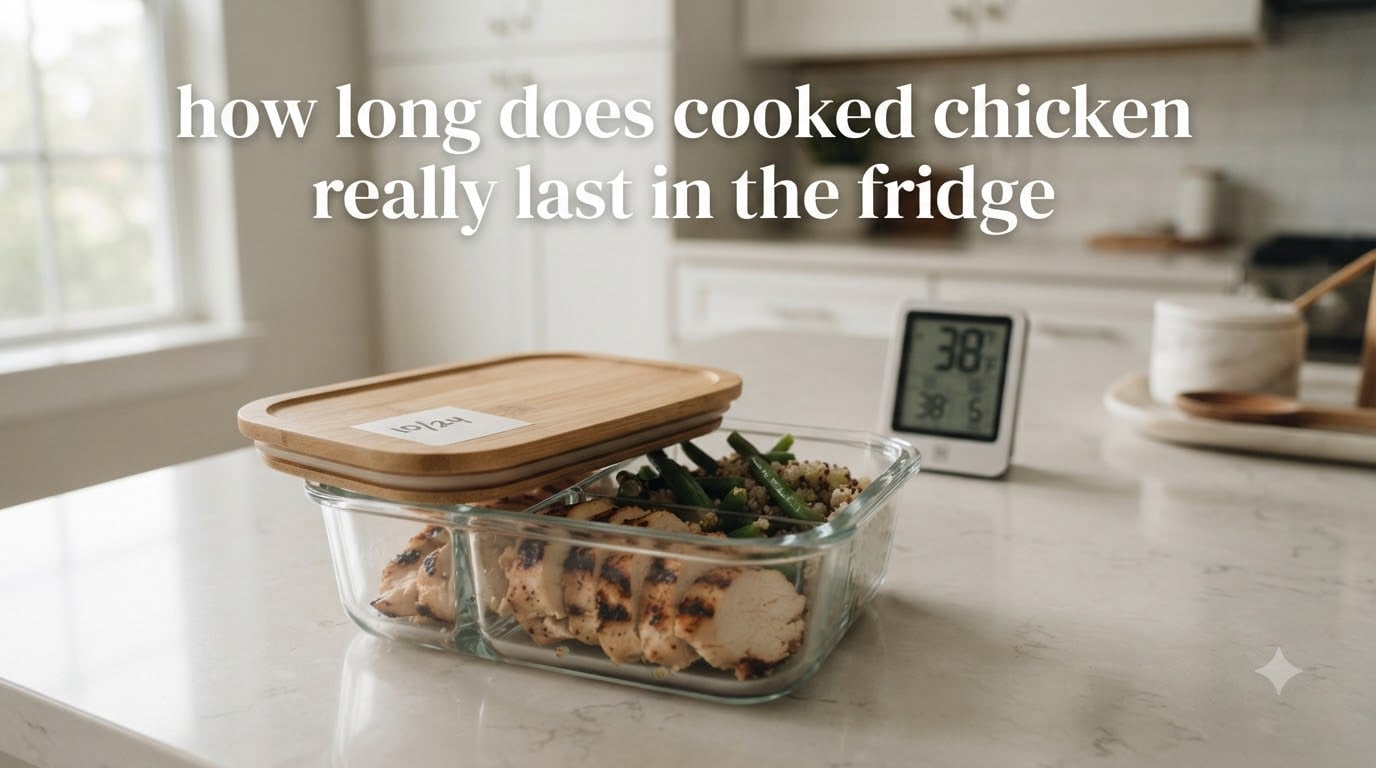
Cooked chicken lasts 3 to 4 days in the fridge when stored at 40°F or below, according to the USDA Food Safety and Inspection Service. That’s the official answer, and it’s the one we’ll anchor this entire guide to.
I know that rule can feel overly conservative. Plenty of home cooks on Reddit and cooking forums insist they’ve eaten 5- and even 7-day-old chicken without a problem. So the word “really” in your question matters. You’re not just asking for the textbook number; you’re asking whether the rule reflects reality. I’ll give you both: the USDA timeline, the science behind it, and an honest look at why some people stretch it and others get sick.
In this guide, you’ll get the direct answer first, a storage-time comparison table, step-by-step storage instructions, a spoilage-signs checklist, the truth about the 5- and 7-day debate, freezing timelines, and safe reheating temperatures. By the end, you’ll know exactly how long your leftover chicken is good for and how to tell when it’s time to let it go.
Table of Contents
How Long Does Cooked Chicken Really Last in the Fridge?
Cooked chicken stays safe to eat for 3 to 4 days in the refrigerator when you store it at or below 40°F (4°C). After day 4, bacterial growth can reach levels that cause foodborne illness, even if the chicken still looks and smells fine.
The USDA’s 3-4 day window covers all common preparations: roasted, grilled, poached, pan-fried, shredded, and rotisserie chicken. The clock starts the moment the chicken finishes cooking, not when you first open the fridge. If you cooked it Sunday at 6 pm and refrigerated it by 7 pm, day 1 is Monday.
Quick Storage Reference
| Storage Method | Safe Duration | Temperature |
|---|---|---|
| Refrigerator (fridge) | 3 to 4 days | 40°F or below |
| Freezer | 2 to 6 months (best quality) | 0°F or below |
| Room temperature (counter) | Maximum 2 hours | Below 90°F: 1 hour max |
| Hot holding (crockpot, warming tray) | Up to 4 hours | 140°F or above |
That counter line is non-negotiable. Cooked chicken left on the counter for more than 2 hours enters the food safety “danger zone” (40-140°F), where bacteria double every 20 minutes. I’ll explain the science behind that in the next section.
Storage Times at a Glance: Fridge, Freezer, and Counter
Different cuts and preparations have slightly different storage behavior, even when the official rule stays at 3-4 days. Here’s how long specific types hold up under proper refrigeration:
| Chicken Type | Fridge Life | Freezer Life | Best Container |
|---|---|---|---|
| Whole roasted chicken | 3-4 days | 4-6 months | Shallow airtight container |
| Chicken breast (cooked) | 3-4 days | 4-6 months | Airtight, separate from sauces |
| Chicken thighs and drumsticks | 3-4 days | 3-4 months | Airtight with juices |
| Shredded chicken | 3-4 days | 2-3 months | Flat freezer bag |
| Rotisserie chicken (store-bought) | 3-4 days | 4 months | Remove from original packaging, debone |
| Chicken soup or stew | 3-4 days | 2-3 months | Glass container, leave 1 inch headspace |
| Fried chicken | 3-4 days | 4 months | Airtight with paper towel to absorb moisture |
| Chicken salad with mayo | 3-5 days | Not recommended | Airtight, never freeze |
Notice the chicken salad exception. Mayonnaise-based salads don’t freeze well because the emulsion breaks, turning the texture grainy when thawed. Eat those within 5 days max and keep them tightly sealed.
Why 3-4 Days and Not Longer? The Science Behind the Rule
The 3-4 day limit isn’t a guess. It’s based on how bacteria multiply in cooked food at refrigeration temperatures.
The Danger Zone Explained
The USDA defines the “danger zone” as 40°F to 140°F. Within this range, bacteria like Salmonella, Staphylococcus aureus, and E. coli can double in number every 20 minutes. Your fridge keeps food at or below 40°F to slow this growth dramatically, but it does not stop it.
Cooking kills most bacteria, but cooked chicken can be recontaminated by hands, utensils, cutting boards, or surfaces during cooling and storage. Once present, those bacteria start multiplying again at refrigerator temperatures, just more slowly.
Why Day 4 Is the Boundary
After roughly 4 days at 40°F, bacterial counts on cooked chicken can climb high enough to cause illness, even though the meat may still look, smell, and taste normal. This is the part that confuses people: dangerous bacteria are often undetectable without lab testing.
Staphylococcus aureus is especially sneaky. It produces heat-stable toxins that survive reheating, so even cooking old chicken thoroughly won’t make it safe if toxins have already formed. The 4-day limit accounts for this.
Why Some People Get Away With 5-7 Days
Several variables explain why your friend ate day-6 chicken and felt fine while someone else got food poisoning from day-5 chicken:
- Starting bacterial load: If the chicken was handled cleanly and refrigerated within an hour of cooking, it starts with fewer bacteria than chicken that sat on the counter for 90 minutes first.
- Fridge temperature consistency: A fridge that holds a steady 36°F gives more margin than one fluctuating between 38°F and 42°F.
- Personal immunity and gut microbiome: Some people fight off low-level bacterial contamination without symptoms.
- Luck: Pathogens are unevenly distributed. One bite might pick up a contaminated pocket; another might miss it.
The USDA guideline protects the most vulnerable scenario, not the best-case one. Following it means you don’t roll the dice.
How to Store Cooked Chicken Properly in the Fridge
Proper storage can push you safely to the full 4 days. Sloppy storage can shorten that window significantly. Here’s the exact method our team uses at home and in test kitchens.
Step 1: Cool the Chicken Quickly
Don’t put hot chicken straight into the fridge. First, cut large pieces into smaller portions so heat escapes faster. Spread pieces on a plate or sheet pan to release steam. Aim to get the chicken below 70°F within 2 hours of cooking.
Step 2: Portion Into Shallow Containers
Use containers no deeper than 3 inches. Shallow containers cool faster in the fridge than deep ones, and quick cooling keeps bacteria from getting a head start. If you have a whole chicken, debone it and split into meal-sized portions before storing.
Step 3: Choose the Right Container
Airtight glass containers with snap-lock lids are ideal because they don’t absorb odors and create a tight seal. BPA-free plastic works too, especially containers designed for leftovers. Zip-top freezer bags work if you squeeze out excess air.
Step 4: Label With the Date
Write the cook date on the container lid or a strip of masking tape. The 4-day window is easy to lose track of, especially with multiple leftovers in the fridge.
Step 5: Place in the Coldest Part of the Fridge
The back of the middle shelf is typically the coldest and most consistent spot. Avoid the door, where temperatures swing every time you open it. Don’t shove containers against the back wall where they might freeze slightly near the coils.
Step 6: Keep the Fridge at 40°F or Below
Put an inexpensive fridge thermometer on the middle shelf. Many fridges run 3-5°F warmer than the dial setting, so verify with a real reading. If your fridge reads 42°F, you’re already outside the safe range.
Glass vs Plastic Containers: Which Keeps Chicken Fresh Longer?
Both glass and plastic work for storing cooked chicken, but they behave differently. Here’s how they compare for chicken storage specifically:
| Factor | Glass Containers | Plastic Containers |
|---|---|---|
| Air seal | Excellent with snap-lock lids | Good, can warp over time |
| Odor absorption | None | Can absorb onion and garlic odors |
| Staining | Rare, usually washes out | Common with turmeric and tomato sauces |
| Microwave safe | Yes (most are) | Check for microwave-safe label |
| Freezer safe | Yes, leave headspace for expansion | Yes, but can become brittle |
| Reheating | Can go straight from fridge to oven | Transfer to plate first for high heat |
| Longevity in storage | Lasts indefinitely | Replace every 2-3 years |
Our recommendation: glass for fridge storage when possible. It seals better, doesn’t absorb odors, and survives years of use. Save plastic for lunches and freezer bags for batch-frozen portions.
How to Tell if Cooked Chicken Has Gone Bad
Even with perfect storage, sometimes chicken is past its prime. Here’s how to spot bad chicken before you take a bite. Spoilage is usually detectable through three signals: smell, texture, and color.
Smell Test
Fresh cooked chicken has a mild, neutral smell. Spoiled chicken gives off a distinctly sour, tangy, or ammonia-like odor. Some describe it as “rotten egg” or “old gym socks.” If you crack the lid and notice anything sharp, acidic, or chemical, throw it out. Don’t taste it to confirm.
Texture Test
Cooked chicken should feel firm but moist. Spoiled chicken often develops a sticky, slimy, or tacky surface, even after rinsing. Sliminess is a clear sign of bacterial growth. If the chicken feels unusually soft, mushy, or gummy, it’s time to discard it.
Color Test
Properly cooked chicken is white (breast) or brownish-gray (thighs and drumsticks). Spoiled chicken may develop gray, green, or yellow patches. Any green or bright yellow discoloration is a definite sign of mold or bacterial growth. Toss the entire container, not just the discolored pieces.
Important Safety Warning
You cannot always tell if chicken is unsafe by smell or appearance alone. Some dangerous bacteria, like Salmonella, produce no obvious odor or color change. The 3-4 day timeline exists precisely because the absence of spoilage signs is not proof of safety. When in doubt, throw it out.
Quick Spoilage Checklist
- Sour, sharp, or ammonia-like smell
- Sticky or slimy surface texture
- Gray, green, or yellow discoloration
- Mold growth (any color)
- Froth or bubbles in the container liquid
- More than 4 days since cooking, regardless of appearance
Can You Eat Chicken 5 or 7 Days After Cooking? Addressing the Real-World Gap
This is where the “really” in your question matters most. Let me be straight with you about what happens beyond day 4.
Day 5 Chicken
Day 5 chicken is past the USDA guideline but still consumed by many experienced home cooks. If your chicken was cooked cleanly, refrigerated within an hour, and stored at 38°F or below, day 5 carries moderate risk. Bacterial counts will be elevated, but may still be below the threshold that causes symptoms in healthy adults.
For meal preppers who cook on Sunday and want to eat through Friday, day 5 is the practical limit. Beyond that, you’re betting on your specific fridge conditions, your starting bacterial load, and your tolerance for risk.
Day 7 Chicken
Day 7 chicken is where the risk gets serious. At 7 days, bacterial counts in cooked chicken can exceed safe thresholds even under ideal storage. People do eat 7-day chicken and feel fine, often because their fridge runs cold, their immune system is robust, and they got lucky.
But food poisoning from day-7 chicken is also well-documented. The Reddit threads celebrating 7-day chicken are survivorship bias: you don’t see the posts from people who got sick because they didn’t post. The USDA doesn’t set guidelines based on what most people can survive; it sets them on what keeps the most vulnerable people safe.
Who Should Follow the Rule Strictly
If you or anyone eating your food is pregnant, elderly, immunocompromised, or a young child, treat the 3-4 day rule as a hard line. These groups are more susceptible to severe complications from foodborne illness. Day-5 chicken might give a healthy adult mild stomach upset and hospitalize someone with a weaker immune system.
Who Has More Flexibility
Healthy adults with reliable fridges can reasonably stretch to day 5 if storage was textbook perfect. Beyond that, the risk-reward stops making sense. Freezing day-3 chicken and using it next week is safer than eating it on day 6.
How to Freeze Cooked Chicken for Long-Term Storage
Freezing is your best tool for extending chicken beyond the 4-day fridge window. Properly frozen chicken stays safe indefinitely, though quality gradually declines after 4 months.
Freezing Instructions
Cool the chicken completely first, ideally within 2 hours of cooking. Portion it into meal-sized servings to avoid thawing and refreezing larger blocks. Wrap tightly in plastic wrap or aluminum foil, then place in a freezer bag with the air pressed out. Label with the date and contents.
Freezer Storage Times by Type
| Chicken Type | Best Quality | Maximum Safe |
|---|---|---|
| Cooked chicken pieces | 4 months | 6 months |
| Shredded chicken | 3 months | 4 months |
| Chicken soup or broth | 3 months | 6 months |
| Chicken with sauce (cream, tomato) | 2 months | 4 months |
| Breaded or fried chicken | 2 months | 4 months |
Thawing Frozen Chicken Safely
Three safe thawing methods: in the fridge overnight (best for quality), in cold water changed every 30 minutes (faster), or in the microwave using the defrost setting (fastest, but cook immediately after). Never thaw chicken on the counter; this is the same danger zone rule that applies to cooked chicken.
Refreezing Thawed Chicken
You can refreeze chicken that was thawed in the fridge and hasn’t been at room temperature for more than 2 hours. If you thawed it using cold water or the microwave, cook it first before refreezing. Refrozen chicken loses moisture and texture, so use it in soups, stews, and casserols where texture doesn’t matter.
How to Safely Reheat Leftover Chicken
Reheating doesn’t make old chicken safe; it just makes stored chicken enjoyable again. But you need to reheat properly to kill any bacteria that grew in storage.
Target Internal Temperature: 165°F
The USDA recommends reheating all cooked poultry to an internal temperature of 165°F (74°C). This temperature kills most bacteria that may have grown during refrigeration. Use a food thermometer to verify, especially when reheating whole pieces or thick cuts.
Reheating Methods Compared
- Oven (best for whole pieces): 350°F for 10-15 minutes, covered with foil to prevent drying. Add a splash of broth or water for moisture.
- Stovetop (best for shredded or sliced): Medium heat in a covered pan with a little oil or broth. Stir frequently.
- Microwave (fastest): Cover and heat in 1-minute intervals, stirring between each. Add a tablespoon of water to prevent drying.
- Air fryer (good for crispy texture): 350°F for 5-7 minutes, works especially well for fried chicken.
Can You Reheat Chicken More Than Once?
Each reheating cycle gives bacteria another chance to multiply if temperatures dip into the danger zone. Reheat only what you’ll eat in one sitting, and avoid reheating the same chicken three or more times. Two rounds of reheating is generally the practical maximum for quality and safety.
Frequently Asked Questions
Can I eat chicken 5 days after cooked?
Eating chicken on day 5 is past the USDA 3-4 day guideline. If your fridge holds a steady 38°F or below and the chicken was refrigerated within an hour of cooking, day 5 carries moderate risk for healthy adults. For pregnant women, elderly people, young children, or anyone immunocompromised, day 5 chicken is not recommended. Freezing on day 3 is a safer option than stretching to day 5.
Is 7 days too long for chicken in the fridge?
Yes, 7 days is too long for cooked chicken in the fridge. By day 7, bacterial counts typically exceed safe thresholds even with ideal storage. While some people eat day-7 chicken without symptoms, the risk of foodborne illness is significant. Freeze chicken by day 3 or 4 if you want to keep it longer than a week.
Is it safe to eat 10 day old cooked chicken?
No, 10-day-old cooked chicken is not safe to eat, even if it looks and smells fine. Dangerous bacteria like Salmonella can be present without any visible signs. After 10 days at refrigeration temperatures, bacterial counts almost certainly exceed thresholds that cause foodborne illness. Discard it.
Can I eat rotisserie chicken after 7 days in the fridge?
Rotisserie chicken follows the same 3-4 day rule as any other cooked chicken. By day 7, it’s well past safe storage limits regardless of whether you bought it from a store or roasted it yourself. If you’ve reached day 4 with leftover rotisserie chicken, remove the meat from the bones and freeze it for future use.
Final Verdict on Cooked Chicken Storage
Cooked chicken really does last 3 to 4 days in the fridge when you store it properly at or below 40°F. That’s the USDA guideline, the science behind it, and the safest answer for everyone from meal preppers to families with leftovers.
If you’re cooking in bulk for the week, plan to either eat your chicken by day 4 or freeze portions on day 2 or 3 for later use. Don’t rely on smell or appearance alone to judge safety, because dangerous bacteria don’t always announce themselves. When in doubt, throw it out.
Set a fridge thermometer on your middle shelf, label your leftovers with cook dates, and keep glass containers on hand for proper storage. Following these steps makes the 4-day window easy to hit and your chicken consistently safe to enjoy.