
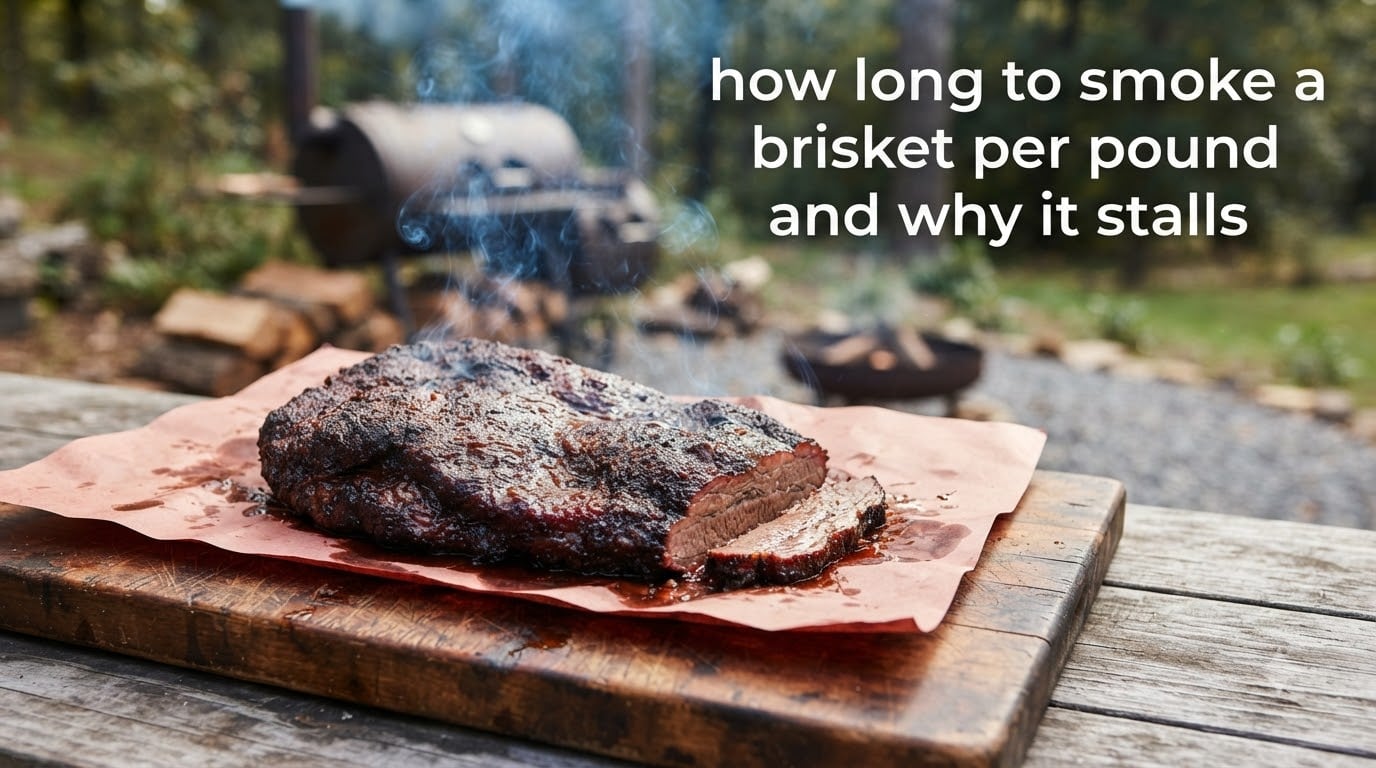
Smoking a brisket takes patience — and a solid understanding of what happens inside that meat over 10, 12, or even 18 hours. Whether you’re firing up your first packer brisket or you’ve smoked dozens and want to understand the science behind the infamous temperature stall, this guide covers everything you need.
I’ve spent years smoking briskets on offset stick burners, pellet grills, and kamado-style cookers. One thing I’ve learned the hard way: timing isn’t just about pounds and temperature. The brisket stall — that maddening plateau where your internal temp refuses to climb — can add hours to your cook if you don’t know what’s happening or how to handle it.
Below, I’ll break down exactly how long to smoke a brisket per pound at different temperatures, explain why the stall happens in plain English, and give you practical strategies for pushing through it without wrecking your bark or drying out the meat.
Table of Contents
How Long to Smoke a Brisket Per Pound
Plan on 1 to 1.5 hours per pound when smoking brisket at 250°F. At 225°F, expect closer to 1.5 to 2 hours per pound. A 12-pound whole packer brisket at 250°F typically takes 12 to 18 hours total, including the stall and a 1-hour rest.
Those numbers assume a full packer brisket (both the flat and the point) with a typical fat cap. Several variables can shift the timing in either direction.
Brisket Smoking Time Chart by Weight
This chart gives you a planning range at three common smoking temperatures. The wide ranges account for the stall, which we’ll cover in detail below.
| Brisket Weight | At 225°F | At 250°F | At 275°F |
|---|---|---|---|
| 8 lbs | 12–16 hours | 8–12 hours | 6–9 hours |
| 10 lbs | 15–20 hours | 10–15 hours | 7.5–11 hours |
| 12 lbs | 18–24 hours | 12–18 hours | 9–13.5 hours |
| 14 lbs | 21–28 hours | 14–21 hours | 10.5–15.5 hours |
| 16 lbs | 24–32 hours | 16–24 hours | 12–18 hours |
These are planning estimates, not exact targets. Always cook to internal temperature and tenderness, not to the clock.
Variables That Change the Timing
Not every brisket behaves the same, even at the same weight and pit temperature. Here’s what shifts the clock:
Fat content and marbling: A well-marbled prime brisket renders faster than a choice or select grade, shortening the cook slightly.
Fat cap thickness: A thick untrimmed fat cap insulates the meat and can slow the temperature climb.
Starting temperature: A brisket straight from the fridge takes longer than one that’s rested at room temperature for an hour.
Smoker type: Pellet smokers with tight temperature control often cook slightly faster than offset smokers with wider temperature swings.
Weather and humidity: Cold, windy, or dry conditions force your smoker to work harder, which can extend the cook. High ambient humidity can lengthen the stall.
Flat vs. whole packer: A brisket flat alone, being thinner and leaner, cooks faster — roughly 45 minutes to 1 hour per pound at 250°F.
What Is the Brisket Stall and Why Does It Happen
The brisket stall is a period during smoking when the internal temperature of the meat plateaus — typically between 150°F and 170°F — and stops rising for one to four hours, even though the smoker is holding steady at its target temperature.
It’s not a malfunction. It’s physics.
Evaporative Cooling: The Science in Plain English
As the brisket heats up, moisture on its surface and within its outer layers starts to evaporate. When water changes from liquid to gas (steam), it absorbs a tremendous amount of energy — a process called latent heat of vaporization. That energy has to come from somewhere, and it comes from the meat itself.
Think of it like sweating. When you step out of a pool on a breezy day, you feel cold even though the air is warm. That chill is evaporation pulling heat from your skin. The brisket is doing the same thing — sweating from its surface — and the evaporation pulls heat out as fast as the smoker puts it in.
The result: the internal temperature flatlines. It can stay stuck at 160°F for two or three hours while the moisture slowly dissipates. Once enough surface moisture has evaporated, the evaporation can no longer keep up with the incoming heat, and the temperature starts climbing again — often quickly.
Why Understanding the Stall Matters
The stall is the number one source of anxiety for first-time brisket smokers. If you don’t expect it, you’ll think something is wrong. You’ll open the lid to check. You’ll wonder if your thermometer is broken. You might even pull the brisket off the smoker hours early, thinking it’s done, and end up with tough, under-rendered meat.
Knowing the stall is coming lets you plan for it instead of panicking through it.
At What Temperature Does Brisket Stall
The brisket stall typically begins around 150°F and resolves around 170°F, with most briskets hitting the plateau somewhere in the 155–165°F range. The exact starting point depends on how much moisture is on and in the meat, the airflow in your smoker, and the ambient humidity.
Why Some Briskets Stall at 185°F Instead of 165°F
This is one of the most common questions on BBQ forums, and it catches people off guard. A brisket can stall at 180–190°F if it has an unusually thick moisture layer, if you’ve been spritzing heavily, or if the humidity in your smoker is high. More moisture means more evaporative cooling, which can keep the temperature suppressed longer and at higher numbers.
It’s not a sign of a problem. It just means there’s still enough surface moisture to slow the temperature climb. Push through it.
Why Some Briskets Skip the Stall Entirely
On the flip side, some briskets seem to blow right past the 150–170°F range without pausing. This is more common on pellet smokers with tightly sealed cooking chambers, in dry climates, or with briskets that have a thin fat cap and minimal surface moisture.
Less moisture on the surface means less evaporative cooling, which means no visible stall. If your brisket didn’t stall, that’s fine — it doesn’t mean you did anything wrong. It just means conditions weren’t right for a pronounced plateau.
How Long Does the Brisket Stall Last
A typical brisket stall lasts 1 to 4 hours, though some can stretch to 6 hours or longer under certain conditions. The duration depends on how much moisture is available for evaporation, the smoker’s airflow, and the ambient humidity.
Stall Duration by Smoker Type
Offset stick burner: Tends to have the longest stalls (2–5 hours) because the open firebox creates more airflow, which accelerates evaporation.
Kamado / ceramic grill: Moderate stalls (1–3 hours) due to the sealed environment retaining more moisture.
Pellet grill: Often the shortest stalls (0–2 hours) because the tight seal and consistent fan-driven heat limit evaporative loss.
If you’re on a pellet smoker and your brisket stalls for only 45 minutes — or doesn’t stall at all — that’s perfectly normal for that type of cooker.
Does a Bigger Brisket Stall Longer?
Not necessarily. A bigger brisket has more mass and more moisture, which could mean a longer stall. But it also has more thermal mass pushing through the stall zone. In practice, the difference in stall duration between a 10-pound and a 16-pound brisket on the same smoker at the same temperature is usually less than an hour.
How to Push Through the Brisket Stall
You have three main strategies for dealing with the stall: wrap the brisket, spritz and ride it out, or raise the pit temperature. Each has trade-offs.
Option 1: Wrap the Brisket (The Texas Crutch)
Wrapping is the most popular and most reliable way to push through the stall. By sealing the brisket in foil or butcher paper, you trap moisture against the surface, which reduces evaporative cooling and lets the internal temperature climb again.
Butcher paper is the preferred choice among experienced pitmasters. It’s breathable enough to let some moisture escape, which preserves your bark better than foil. Wrap at 165°F internal and continue smoking until the brisket reaches 203°F or feels probe-tender.
Aluminum foil creates a tighter seal and pushes through the stall faster, but it can soften the bark into a steamed texture. If you go with foil, consider unwrapping for the last 20–30 minutes to re-firm the bark.
Option 2: Spritz and Ride It Out (No Wrap)
If you want the best possible bark and are willing to wait, skip the wrap entirely. Spritz the brisket with apple cider vinegar, beef broth, or water every 45–60 minutes to keep the surface from drying out while maintaining airflow for maximum smoke flavor.
Unwrapped briskets produce a darker, crunchier bark — the hallmark of competition-style BBQ. The trade-off is a longer stall and a slightly higher risk of the flat drying out if you overshoot the final temperature.
Option 3: Raise the Pit Temperature
Bumping your smoker from 225°F to 275°F or even 300°F during the stall increases the heat input faster than evaporation can pull it away. This is the “hot and fast” approach, and it works — many competition pitmasters cook at 275°F from the start and experience shorter, less dramatic stalls.
The risk is that higher temperatures can dry out the flat if you’re not careful. This method works best in combination with wrapping.
When Should You Wrap?
The best time to wrap is when the brisket hits 160–170°F internal and you can see the bark has set — it should look dark mahogany and feel firm to the touch. Don’t wrap too early, or you’ll trap moisture before the bark has formed, resulting in a soft, steamed exterior.
When to Pull Brisket After the Stall
Pull the brisket when it reaches 200–205°F internal temperature and the probe slides into the thickest part of the flat with almost no resistance — the “probe tender” test. This is more reliable than hitting a single number on a thermometer.
Why 203°F Is the Magic Number
At around 203°F, the collagen in the brisket has fully converted to gelatin, the intramuscular fat has rendered, and the connective tissue has broken down. This is what transforms a tough cut of beef into something you can pull apart with your fingers.
But not every brisket hits probe tenderness at exactly 203°F. Some are done at 198°F, others need 207°F. The probe test tells you what the thermometer can’t — whether the texture is right.
What Is Probe Tenderness?
Insert a thermometer probe or a thin skewer into the thickest part of the flat. It should slide in with the same resistance as pushing into soft peanut butter or warm butter. If you feel any firmness or “grab,” the brisket needs more time.
Carryover Cooking After Pulling
When you pull the brisket off the smoker, the internal temperature will continue to rise 5–10°F during the rest. If your brisket feels probe-tender at 198°F, the carryover will bring it past 203°F on its own. Don’t fight the carryover — use it to your advantage.
Resting Your Brisket
Rest the brisket for a minimum of 1 hour, and ideally 2 to 4 hours, before slicing. Resting allows the muscle fibers to relax and the juices to redistribute. Skip the rest and you’ll lose a significant amount of moisture the moment you cut into it.
How to Rest Brisket Properly
Wrap the brisket in butcher paper (if it isn’t already) and place it in a dry, empty cooler — no ice. The insulated environment holds the brisket at a food-safe temperature for 4+ hours. This is how restaurants and competition teams hold briskets for hours before service.
If you don’t have a cooler, set the wrapped brisket on a sheet pan on your kitchen counter, loosely tented with a towel. This works for shorter rests of 1–2 hours.
Can You Rest Brisket Too Long?
Yes. After about 6 hours in a cooler, the brisket can overcook from its own residual heat, and the bark can soften. For rest periods longer than 4 hours, use a cooler with a few towels to insulate but check the internal temperature periodically. If it drops below 140°F, you’ve entered the food safety danger zone.
Troubleshooting Common Stall Issues
Not every brisket cook follows the textbook. Here are the most common stall-related problems and what to do about them.
My Brisket Never Stalled — Is Something Wrong?
No. If your brisket sailed through the 150–170°F range without a noticeable pause, that’s fine. Pellet smokers in particular tend to produce shorter or nonexistent stalls because the sealed cooking chamber limits airflow and evaporative cooling. The brisket can still turn out tender and delicious without a visible stall.
My Brisket Stalled at 185°F Instead of 165°F
This happens more often than people realize, and it’s usually caused by heavy spritzing, high humidity in the smoker, or a thick moisture layer from the rub binding. It’s not a problem — it’s just a delayed stall. Wrap if you want to speed things up, or keep cooking unwrapped. The brisket will push through on its own.
My Brisket Has Been Stalling for Over 5 Hours
A stall that lasts more than 5 hours usually means one of two things: either your smoker temperature is running lower than you think (double-check with a separate thermometer), or you’re cooking in very humid conditions. Wrapping will fix both problems by cutting off evaporative cooling entirely.
The Flat Is Done but the Point Is Still Tough
The point has more intramuscular fat and connective tissue, so it sometimes needs more time than the flat. This is one reason competition cooks separate the flat and point after the wrap — they can pull the flat when it’s probe-tender and keep the point going until it reaches the same texture.
How to Plan Your Brisket Cook Around a Target Time
One of the hardest parts of smoking brisket isn’t the cook itself — it’s timing the cook so the brisket is ready when you want to eat. Here’s how to plan backward from your target meal time.
The Backward Planning Method
Decide when you want to eat. Say, 6:00 PM.
Subtract the rest time. For a 2-hour rest, you need the brisket off the smoker by 4:00 PM.
Estimate total cook time using the per-pound formula. For a 14-pound brisket at 250°F, plan for 14 to 21 hours. Use the midpoint (17.5 hours) as your baseline.
Work backward from 4:00 PM. 17.5 hours before 4:00 PM is 10:30 PM the night before.
Add a 2-hour buffer. The stall can be unpredictable. Starting at 8:30 PM gives you room to absorb an extra-long stall without missing dinner.
If the brisket finishes early, wrap it and hold it in a cooler. A brisket can safely hold for 4+ hours in a well-insulated cooler. It’s much better to finish early than late.
Should You Smoke Brisket Overnight?
For any brisket over 10 pounds at 225–250°F, an overnight cook is almost inevitable. The key is maintaining stable temperature while you sleep. Pellet smokers and kamado grills with temperature controllers handle this well. If you’re on an offset, you’ll need to set alarms and manage the fire every 1–2 hours.
Frequently Asked Questions
How long does it take to smoke a brisket per pound?
At 250°F, plan for 1 to 1.5 hours per pound. At 225°F, expect 1.5 to 2 hours per pound. A 12-pound packer brisket at 250°F typically takes 12 to 18 hours total, including the stall and a 1-hour rest. Always cook to internal temperature and probe tenderness, not to the clock.
Why does brisket stall when smoking?
The brisket stalls because of evaporative cooling. As the meat heats up, moisture on its surface evaporates, absorbing heat energy in the process (latent heat of vaporization). This pulls heat out of the brisket as fast as the smoker puts it in, causing the internal temperature to plateau — typically between 150°F and 170°F — for one to four hours.
At what temperature does the brisket stall happen?
Most briskets stall between 150°F and 170°F, with the most common plateau around 155–165°F. Some briskets stall higher (180–190°F) if there is heavy spritzing or high humidity. Others skip the stall entirely, especially on sealed pellet smokers with low evaporative loss.
How long does the stall usually last on a brisket?
A typical stall lasts 1 to 4 hours. Offset smokers with high airflow can see stalls of 5+ hours, while pellet grills may stall for less than an hour or not at all. The duration depends on moisture levels, airflow, and ambient humidity.
How do you push through a brisket stall?
You have three options: wrap the brisket in butcher paper or foil to trap moisture and reduce evaporative cooling, spritz and ride it out unwrapped for the best bark, or raise your pit temperature to 275–300°F to overpower the evaporative cooling with more heat input. Wrapping at 165°F in butcher paper is the most popular approach.
What temperature should you pull brisket after the stall?
Pull the brisket at 200–205°F internal temperature when the probe slides into the thickest part of the flat with no resistance — the probe tenderness test. Many briskets hit this at exactly 203°F, but the probe test is more reliable than any single number. Rest for at least 1 hour before slicing.
Does wrapping brisket help with the stall?
Yes. Wrapping traps moisture against the brisket’s surface, which stops evaporative cooling and allows the internal temperature to resume climbing. Butcher paper preserves more bark texture than foil. Wrap when the bark is set (dark mahogany and firm), usually around 160–170°F internal.
Conclusion
Understanding how long to smoke a brisket per pound — and why the stall happens — takes the guesswork and panic out of one of the most intimidating cooks in barbecue. Plan for 1 to 1.5 hours per pound at 250°F, expect a stall somewhere around 150–170°F, and decide in advance whether you’ll wrap, wait, or raise the heat. Cook to probe tenderness, not the clock, and give that brisket the rest it deserves. Do those things, and you’ll have a brisket worth bragging about — every time.