
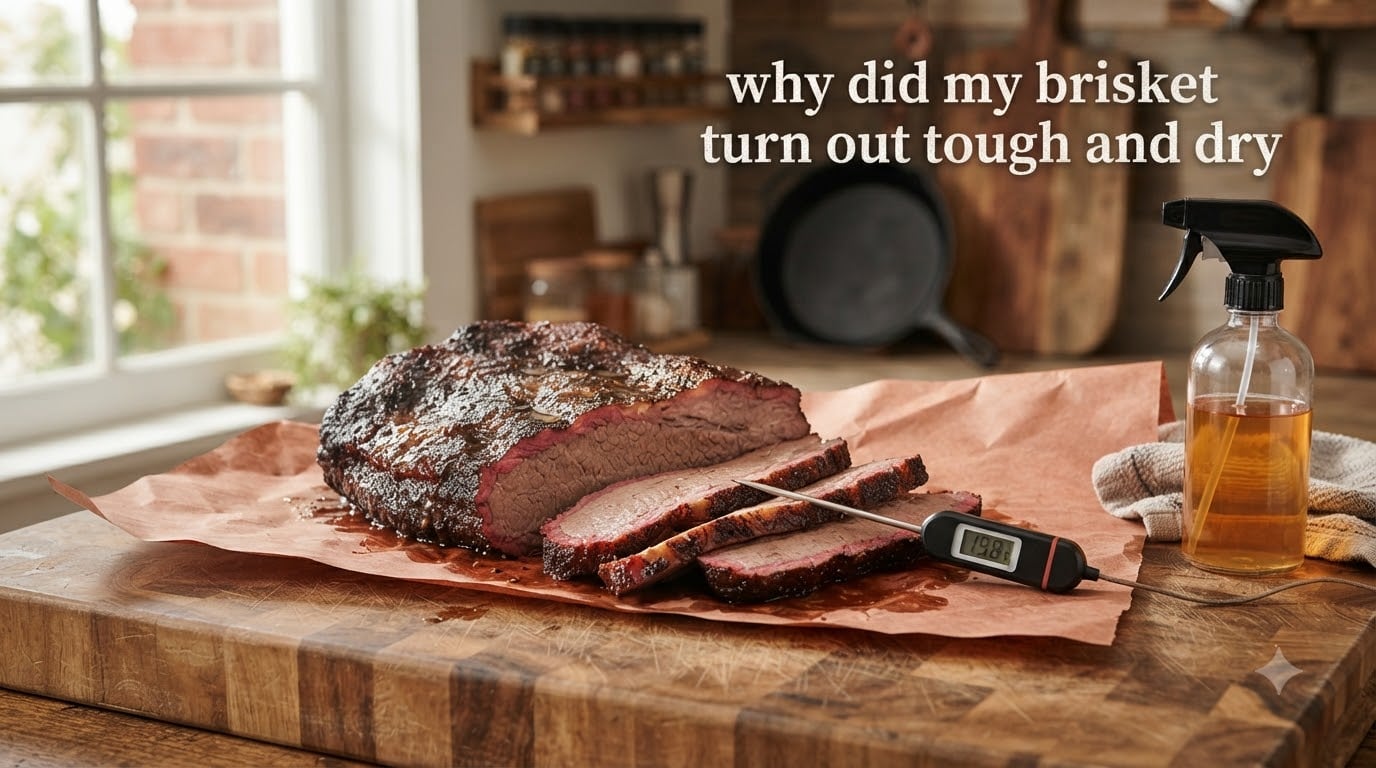
You spent 12 hours on a brisket, watched the smoker all afternoon, and when you finally sliced into it, the meat came out tough, dry, and stringy. It happens to almost every home cook at least once. If you’re wondering why did my brisket turn out tough and dry, the short answer is that brisket is one of the most unforgiving cuts in barbecue, and almost every “bad” brisket fails for the same handful of reasons.
The good news: every one of those reasons is fixable on your next cook. I have broken down the five most common culprits below, then walked through the science, the technique, and the recovery options if you already have a tough brisket sitting on your counter right now.
Table of Contents
Quick Answer: The 5 Most Common Reasons a Brisket Turns Out Tough and Dry
- It was undercooked. Collagen needs hours at low heat to convert to gelatin. Pulling the brisket before it hits probe-tenderness leaves chewy connective tissue behind.
- It was overcooked. Going past 210°F without checking tenderness pushes moisture out of the meat and leaves a dry, crumbly texture.
- You sliced with the grain. Brisket muscle fibers run long. Slicing parallel to them produces long, chewy strings instead of tender bites.
- You skipped (or shortened) the rest. Cutting right off the smoker lets all the juice run onto the board. A short rest evaporates moisture instead of redistributing it.
- You cooked too hot, too dry, without wrapping. High heat, low humidity, and no wrap during the stall drive moisture out of the meat before fat has a chance to render.
If one of those five points describes your last cook, you have your answer. Read on for the science behind each problem and the specific fix that will change your next brisket.
Why Brisket Goes Tough: The Collagen Science You Need to Know
A whole packer brisket is roughly 30 percent connective tissue by weight. That tissue is mostly collagen, a tough protein that wraps the muscle fibers and holds the flat and point together.
Collagen does not melt like fat. It converts into gelatin, and that conversion only happens when the meat sits at low cooking temperatures for a long time. Below 140°F, nothing meaningful happens. Between 160°F and 205°F, the collagen molecules slowly unravel and dissolve into the surrounding juices. That is why a low-and-slow cook (225 to 275°F) for 1 to 1.5 hours per pound is the standard, and why hot-and-fast methods (300°F+) are riskier.
When brisket feels rubbery or tough after cooking, the collagen conversion did not finish. Either you pulled the meat too early, the cook was too hot and too short for that grade of beef, or the stall tricked you into thinking the meat was done when it had simply paused.
Prime grade briskets have more intramuscular fat (marbling), which gives you a wider margin of error. Choice grade briskets are leaner, and that is one reason cooks at the same temperature can produce different results. If you have lost two briskets in a row, upgrading to Prime for one cook is a cheap experiment that often reveals how much grade matters.
Why the Flat Dries Out Faster Than the Point
The single most common complaint I see on smoking forums goes like this: “My brisket was perfect on the point end, but the flat was dry.” That is not bad luck. It is anatomy.
The flat is the long, lean muscle that makes up the bulk of a brisket. The point is thicker, fattier, and better insulated. During a long cook, the flat reaches pull temperature 30 to 60 minutes before the point, which means it keeps losing moisture while you wait for the point to finish.
Three practical fixes solve this:
- Separate the muscles early. Once the flat hits 165°F in its thickest part, you can slide a knife along the fat seam and split the flat from the point. Wrap and finish them independently.
- Shrink the flat’s exposure to heat. Place the thicker point end toward the hottest part of the smoker (usually the back) so the flat sits in slightly cooler air.
- Use a water pan. A disposable aluminum pan with hot water in the bottom of the smoker raises humidity and slows surface evaporation on the flat. This single change has saved more briskets in my backyard than any other trick.
Internal Temperature and Probe-Tenderness: How to Know Brisket Is Actually Done
Many home cooks pull the brisket at a specific number, then wonder why the meat is still tough. The honest answer is that internal temperature alone is a guideline, not a finish line.
Most competition-style briskets finish between 203°F and 207°F in the thickest part of the point, but I have pulled tender briskets at 198°F and tough ones at 210°F. The reliable test is probe tenderness: slide an instant-read thermometer probe into the meat. If it slides in like a warm stick of butter with zero resistance, the brisket is done. If it meets any firmness or stickiness, the collagen has not finished converting.
Check probe tenderness in three places: the thickest part of the point, the middle of the flat, and the thin tip of the flat. The thin end of the flat is where most cooks overcook the brisket because that spot hits 200°F long before the rest of the meat is tender.
A quick reference for doneness windows:
- 195 to 200°F: Usually too early. Collagen still working. Only pull here if the probe feels like butter.
- 203 to 207°F: The typical finish range for a full packer brisket.
- 210°F and up: You are entering the overcooked zone. Pull only when probe-tender, not on the number alone.
How to Slice Brisket Against the Grain (and Why Slicing Wrong Makes It Tough)
Slicing against the grain is the single biggest tenderness mistake, and it is the easiest to fix. Muscle fibers in a brisket are long, bundled ropes. When you cut parallel to them, you leave those ropes intact, so each bite has to be chewed through dozens of fibers at once. Slice across them, and you cut each rope into short pieces that fall apart on the tongue.
To slice correctly, lay the flat on the board with the fat cap up. Look closely. You will see thin lines running diagonally across the meat, like wood grain. Rotate the brisket so those lines run left to right in front of you. Then cut perpendicular to them in smooth, pencil-width slices (about 1/4 inch thick).
The point muscle has a different grain direction than the flat, which is one more reason to separate them. Slice the point across its own grain, usually at a 90-degree angle from how you sliced the flat. If you cut both muscles with the same knife stroke, one of them will be sliced wrong.
If your brisket turns out stringy even though you cooked it perfectly, this is almost always why. A sharp knife helps too. A long slicing knife or a brisket knife with a granton edge glides through the meat instead of tearing it.
Resting the Brisket: Why Skipping the Rest Wrecks Texture
The rest is not a pause to wait for guests. It is the final stage of cooking. During the rest, three things happen at once: residual heat continues to cook the meat, juices redistribute from the center back to the edges, and the muscle fibers relax so they hold onto more juice when sliced.
Skip the rest, and every drop of juice that should stay in the meat runs onto your cutting board within seconds of the first cut. Even a brisket cooked perfectly will taste dry and tough without a long enough rest.
Aim for at least 1 hour of rest, and up to 4 hours. The most popular method among competition teams is the hot hold: wrap the brisket in butcher paper and place it in an empty dry cooler (no ice) for 2 to 4 hours. The cooler holds heat and lets carryover cooking finish the job.
Plan for carryover cooking. Internal temperature will rise 5 to 10°F during the rest. If you pull the brisket at 200°F expecting it to coast to 205°F in the cooler, you are right on target. If you pull at 210°F and rest for 3 hours, you may end up at 218°F, which is why the flat feels crumbly and dry.
Moisture Retention: Spritzing, Wrapping, and the Stall
Around 160°F to 170°F, every brisket hits the stall: the internal temperature plateaus for 1 to 4 hours because evaporative cooling on the surface equals the heat coming in. The stall is normal. The decision you make during the stall is what separates juicy brisket from dry brisket.
The two main wrap options:
- Butcher paper (pink or peach): Breathable. Protects the bark from getting soft, lets some moisture escape, and is the competition standard. My first choice for briskets I want to slice and serve.
- Foil wrap: Fully sealed. Traps steam, speeds the cook past the stall, and produces a more pot-roast-style texture. Great for rushing a cook or for tougher Choice grade briskets.
Wrap when the bark is set and dark mahogany (usually around 165°F to 170°F internal) and the surface feels dry to the touch. Wrapping too early gives you a soft, mushy bark. Wrapping too late means the flat has already dried out.
Spritzing helps the bark set and adds a touch of moisture. After the first 90 minutes, spritz the brisket every 45 to 60 minutes with apple juice, a 50/50 mix of apple juice and water, or beef broth. Skip the spritz in the first hour so the rub can form a dry surface, and stop once you wrap.
One more moisture tip: place a water pan in the smoker. A pan of hot water under the brisket keeps the cooking environment humid and slows surface evaporation throughout the entire cook, not just during the stall.
How to Save an Already-Tough Brisket
If a tough brisket is already sitting in front of you, you have more options than you think. A brisket that is chewy but not burnt is salvageable.
- Chop it. Chopped brisket sandwiches are forgiving. Chop the meat finely, mix with a little warm au jus or barbecue sauce, and pile it on a bun. The smaller pieces hide the toughness.
- Reheat in broth. Place sliced brisket in a slow cooker with beef broth, onions, and a splash of Worcestershire. Cook on low for 2 to 3 hours. The liquid rehydrates the meat and softens the texture.
- Turn it into burnt ends. Cube the point (or any section that is dry), toss with rub and a thin layer of sauce or honey, and return to the smoker at 250°F for 90 minutes. Burnt ends are meant to be chewy and caramelized, so a tougher cut is perfect here.
- Make brisket chili or stew. A long simmer in liquid breaks down the last bits of connective tissue. Brisket chili is one of the best uses for a cook that did not go as planned.
- Slice thinner. If the meat is just slightly tough, slice it razor-thin (1/8 inch) against the grain. Thin slices feel tender even when thicker ones do not.
Common Brisket Mistakes Checklist for Your Next Cook
Before the next brisket goes on the smoker, run through this quick list. If you can answer “yes” to every item, your chances of a tender, juicy result go way up.
- Cavities trimmed to 1/4 inch of fat cap, not bare meat.
- Smoker holding steady at 225 to 275°F for the entire cook.
- Water pan in the smoker for humidity.
- Spritzing every 45 to 60 minutes after the first 90 minutes.
- Wrapped in butcher paper at 165 to 170°F when the bark is set.
- Pulled at probe-tenderness in the point, flat, and thin tip, not by temperature alone.
- Rested in a dry cooler for at least 1 hour, up to 4 hours.
- Sliced thin, across the grain, with the flat and point separated.
Skip even one of those steps and the brisket can still turn out tough. Nail all of them and the meat will be the tenderest thing on your table.
Frequently Asked Questions
Why is my brisket tough after cooking?
A brisket is tough after cooking because the collagen in the connective tissue did not fully convert to gelatin. This usually means the meat was pulled too early, the cook ran too hot, or probe-tenderness was never checked. Cook to 203-207°F in the thickest part of the point and confirm the probe slides in like warm butter before pulling.
Why did my brisket come out dry?
A brisket comes out dry when moisture escapes faster than fat can render and replace it. The most common causes are cooking too hot, skipping the wrap during the stall, not spritzing, slicing too early, and resting for too short a time. Rest the brisket for at least one hour and slice against the grain in pencil-width pieces to keep every bite juicy.
How do you fix tough brisket?
Fix tough brisket by chopping it for sandwiches, reheating slices in beef broth, cubing the point into burnt ends, or slow-simmering the meat into chili or stew. Liquid and smaller pieces both help mask or soften the chew. For future cooks, pull the brisket at probe-tenderness around 203-207°F and rest it 1-4 hours in a dry cooler.
What makes brisket tough vs tender?
Brisket is tough when collagen stays intact and tender when collagen converts to gelatin. Low, steady heat (225-275°F) over many hours converts collagen, while high heat or short cooks leave it chewy. Marbling, fat cap, and grade also matter: Prime briskets have more intramuscular fat and stay tender more easily than Choice.
How long should you cook a brisket so it is not tough?
Plan on 1 to 1.5 hours per pound at 225-275°F for a typical packer brisket. A 12 pound brisket usually takes 12 to 16 hours including the stall. Always cook to probe-tenderness instead of a fixed time, since every brisket behaves differently based on grade, fat content, and smoker behavior.
Does brisket get more tender the longer you cook it?
Yes, up to a point. Brisket becomes more tender as collagen converts to gelatin during a long cook, but only until the moisture is gone. Once internal temperature climbs past 210°F without checking probe-tenderness, the meat dries out and turns crumbly. Tender and juicy is the goal, not simply longer.
How do you keep brisket moist when smoking?
Keep brisket moist by maintaining 225-275°F smoker temperature, spritzing with apple juice every 45-60 minutes after the bark sets, wrapping in butcher paper at 165-170°F, placing a water pan in the smoker for humidity, and resting the brisket for at least one hour before slicing.
What is the best internal temperature for brisket?
The best internal temperature for brisket is usually 203 to 207°F in the thickest part of the point, but the real test is probe-tenderness. A probe should slide into the meat with no resistance, like a warm stick of butter. Some briskets finish at 198°F and others at 210°F, so feel matters more than the number.
Why is my smoked brisket dry on the ends?
Smoked brisket is dry on the ends because the thin tip of the flat reaches high temperatures long before the rest of the meat. It loses moisture while you wait for the point to finish. Separate the flat and point early, wrap the thin tip in extra butcher paper, or pull the flat off the heat once it hits probe-tenderness while the point keeps cooking.
Should you wrap a brisket to keep it moist?
Yes, wrapping a brisket during the stall helps lock in moisture and power through the temperature plateau. Pink butcher paper is the most popular wrap because it protects the bark while still letting some steam escape. Foil traps more moisture and speeds the cook but softens the bark.
Can you overcook a brisket?
Yes, you can overcook a brisket. Past about 210°F, the muscle fibers squeeze out the last of their moisture and the meat turns dry and crumbly. Always pull at probe-tenderness, not at a fixed number, and remember that carryover cooking will add 5-10°F during the rest.
What does overcooked brisket look like?
Overcooked brisket has a dry, crumbly texture, slices that fall apart instead of holding together, a mushy or overly soft bark, and visible muscle separation. Juice runs out immediately on the cutting board instead of staying in the meat. If you see these signs, plan to chop, reheat in broth, or turn the meat into burnt ends.
How do you know when brisket is done?
Brisket is done when a thermometer probe slides into the thickest part of the point with zero resistance, like a warm stick of butter. Internal temperature usually lands between 203 and 207°F, but the feel of the probe matters more than the number. Check the point, the middle of the flat, and the thin tip before pulling.
Why is my brisket stringy?
Brisket is stringy because it was sliced with the grain instead of against it. The long muscle fibers stay intact when cut parallel, so each bite feels chewy. Look for the grain direction on the flat, rotate the meat so the lines run left to right, and slice across them in pencil-width pieces. Separate the point from the flat since they have different grain directions.
Do you slice brisket with or against the grain?
Always slice brisket against the grain. Cutting perpendicular to the muscle fibers shortens them so each bite feels tender. On the flat, the grain runs diagonally, so rotate the meat until the lines run left to right. The point has its own grain at a different angle, so separate the two muscles and slice each one across its own grain.
Final Thoughts on Why Your Brisket Turned Out Tough and Dry
If your last brisket was tough and dry, the cause is almost always one of five things: it was undercooked, overcooked, sliced with the grain, not rested long enough, or cooked in a hot dry environment without a wrap. None of those are bad luck. They are habits you can change on the next cook.
Start with the science: brisket becomes tender when collagen converts to gelatin over a long, low cook. Pull the meat at probe-tenderness around 203 to 207°F. Rest it 1 to 4 hours in a dry cooler. Slice the flat and point separately, each one across its own grain. Those four steps solve the question of why did my brisket turn out tough and dry for most home cooks, and they will turn your next brisket into the tenderest thing on the table.