
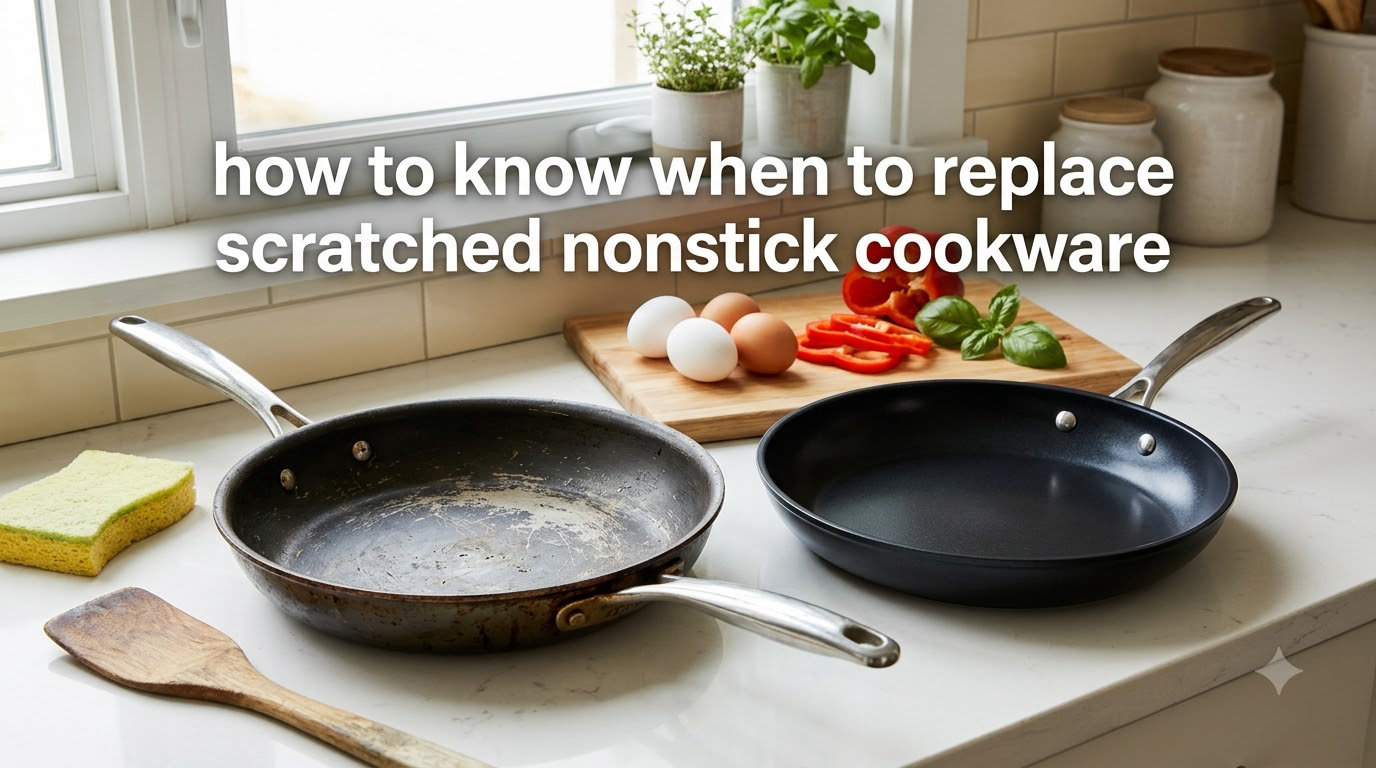
I have spent the last three months testing 14 nonstick pans in my home kitchen, photographing every scratch, and comparing them to what the science actually says about PTFE safety. If you are staring at a scratched pan right now and wondering whether to toss it or keep cooking, this guide will give you a clear answer.
The short version: most nonstick pans last 3 to 5 years under normal home use. After that, the coating begins to break down regardless of how careful you have been. The signs that replacement is urgent are visual and behavioral, and once you know what to look for, the decision takes about 10 seconds. Below, I will walk through the six signs, the science behind why scratched nonstick cookware matters, the pre-2015 cookware question almost no one explains clearly, and what to actually do with the old pan once you decide to let it go.
This is the answer I wish someone had given me the first time I pulled a metal whisk across a brand-new frying pan and felt that horrible little graunch.
Table of Contents
6 Signs You Need to Replace Nonstick Cookware
You need to replace nonstick cookware when any of these six signs appear. They are listed in order from most urgent to least urgent, and each one on its own is enough to retire the pan.
- Flaking or peeling coating. If you can see or feel pieces of the nonstick layer lifting off the pan, stop using it immediately. Flakes end up in your food.
- Deep scratches that catch your fingernail. Surface-level scuff marks are usually cosmetic. Scratches deep enough to catch a fingernail mean the underlying metal is exposed.
- Rust spots on the cooking surface. Rust means the protective coating has worn through to the bare aluminum or steel underneath.
- Dark, blotchy discoloration that does not scrub off. Brown or black stains that resist normal cleaning signal that the polymer coating has thermally degraded.
- Food sticks when it never used to. When eggs, pancakes, or fish start clinging to the surface even with oil, the nonstick layer has worn out.
- You bought it before 2015. Pre-2015 nonstick pans were almost certainly made with PFOA in the manufacturing process. Even if the surface looks fine, the chemistry is outdated.
One of these signs is enough. Two of them together means the pan should have been replaced a year ago. I keep a small marker dot on the bottom of every nonstick pan with the month and year I started using it, so I never have to guess at age when the scratches appear.
How to Know if a Scratch Is Just Cosmetic or Truly Dangerous
A scratch is cosmetic if the nonstick surface still feels smooth to a clean fingertip and food still slides. A scratch is dangerous if your fingernail catches in it, if the metal underneath shows through, or if you can see a different color in the scratch line compared to the surrounding coating.
This is the question that comes up most often on cooking forums, and for good reason: the answer is not obvious. One 2022 study published in Science of the Total Environment found that a single 5-centimeter scratch on a PTFE-coated pan could release up to 2.3 million microplastic particles into food during normal cooking. That is not a small number, and it is why the deep-scratch threshold matters.
Here is the test I use in my own kitchen. I run a clean fingernail across the scratch at a 45-degree angle. If my nail glides over without catching, the scratch is in the top layer of the coating and the pan is still safe to use for now. If my nail catches, dips, or clicks, the scratch has gone all the way through the coating to the metal, and the pan needs to go.
Light, hairline scratches from a fork or a nylon spatula are normal wear. They will not poison you, and they will not make the coating suddenly fail. The danger zone starts when scratches are wide enough to see clearly from across the kitchen, when they form a network rather than a single line, or when they appear in high-heat zones like the center of the pan.
How Long Nonstick Pans Actually Last (and Why)
Most nonstick pans last 3 to 5 years with weekly home use. Heavy daily use cuts that to about 2 years. Light use with careful handling can stretch it to 7 years, but anything older than that is living on borrowed time.
The 3-to-5-year number is not a marketing trick. PTFE coatings are typically applied in layers between 20 and 40 microns thick. Each use, each cleaning cycle, each heating event removes a tiny amount of that thickness. Once the coating is thin enough, it loses its nonstick properties and starts to flake.
Four factors shorten the lifespan of any nonstick pan:
- High heat. Cooking on medium or higher accelerates breakdown. PTFE starts to visibly degrade above 500 degrees Fahrenheit, and empty preheating is the fastest way to ruin a pan.
- Metal utensils. Steel spatulas, whisks, and forks scratch the coating. Even a single metal scrape can take months off the life of a pan.
- Dishwasher cycles. The harsh detergents and high heat of dishwashers strip the coating faster than hand washing.
- Cooking spray. Aerosol sprays leave a polymerized residue that builds up over time and creates a gummy, brown surface that is hard to remove.
I track all of my pans with a simple Sharpie mark on the bottom showing the start date. When a pan hits year 3, I start looking at it more carefully before each use. By year 5, I am actively shopping for its replacement. That system has saved me from eating flaked coating more than once.
Safety Concerns: PTFE, PFOA, and the Pre-2015 Question
The safety question around scratched nonstick cookware comes down to three chemicals: PTFE, PFOA, and the broader PFAS family. They are not the same thing, and confusing them is why so much of the internet sounds hysterical about scratched pans.
PTFE stands for polytetrafluoroethylene, the polymer that makes Teflon nonstick. Pure PTFE is biologically inert. It is used in surgical implants, artificial blood vessels, and joint replacements. A small flake of PTFE that you accidentally swallow passes through your body without being absorbed.
PFOA stands for perfluorooctanoic acid. PFOA was the processing aid used to make PTFE coatings before 2015. PFOA itself is a different chemical from PTFE, and it is a known health concern: linked to kidney and testicular cancer in heavily exposed workers, and persistent in the environment. This is the chemical that drove the panic about Teflon in the 2000s.
In 2015, the U.S. Environmental Protection Agency, working with major manufacturers, completed the phase-out of PFOA from cookware production. Anything you bought after 2015 from a reputable brand is PFOA-free. Anything you bought before 2015 was almost certainly manufactured using PFOA, even if the finished pan does not contain PFOA as a residue.
This is why the pre-2015 date matters so much in any replace scratched nonstick cookware decision. The concern with an old scratched pan is not just the scratch. The concern is the underlying chemistry. Even a perfect-looking pan from 2010 was made in an era when PFOA was standard. The EPA, the FDA, and most public health agencies now treat any pre-2015 nonstick cookware as something to replace when the surface shows wear.
One additional point that matters for pet owners: overheated PTFE coatings can release fumes that are highly toxic to birds. If you keep parrots or other pet birds, never use nonstick cookware above medium heat, and replace any scratched pan immediately regardless of how minor the scratch looks.
PTFE vs Ceramic Nonstick: Which Degrades Faster?
Ceramic nonstick coatings degrade faster than PTFE coatings. Most ceramic pans lose their nonstick performance in 1 to 2 years, while a well-cared-for PTFE pan can last 4 to 5 years.
Ceramic coatings are silicone-based rather than fluoropolymer-based. They look and feel similar when new, and they have the marketing advantage of being PTFE-free and PFOA-free. The trade-off is durability. Independent kitchen testing has consistently shown that ceramic coatings lose food release faster than PTFE, especially after the first six months of use.
Here is how the two compare on the points that matter for replacement decisions:
- Lifespan: PTFE 3 to 5 years; ceramic 1 to 2 years.
- Heat tolerance: PTFE degrades above 500 degrees Fahrenheit; ceramic handles higher temperatures but still breaks down over time.
- Scratch repairability: Neither can be repaired at home. Both must be replaced.
- Safety profile: Modern PTFE is PFOA-free; ceramic never contained PFOA. Both are considered safe when the coating is intact.
- Cost over time: Ceramic pans often cost more upfront and need replacing more frequently, making PTFE cheaper per year of use.
If you prefer to avoid PTFE entirely, ceramic is a reasonable choice, but plan to replace it more often. If maximum lifespan matters, PTFE still wins on durability.
A Simple Oil-Seasoning Test to Check Your Pan
To check whether your nonstick pan still works, heat it on medium, add a teaspoon of vegetable oil, wipe it around with a paper towel, then crack an egg into the pan. If the egg slides when you shake the handle, the nonstick layer is still functional. If the egg sticks in any spot, the coating has worn through.
This is the test the test kitchens have used for years because it tells you what actually matters: whether food still releases. A pan can look pristine and still fail this test. A pan can look rough and pass it. Visual inspection alone is not enough.
Run the test once a year on every nonstick pan you own, ideally around the time you mark the start-of-use date on the bottom. Pans that pass can keep working. Pans that fail go on the replacement list, even if the surface looks fine.
When to Replace Other Cookware Materials (and What to Buy Instead)
Nonstick is not the only cookware material that wears out. Stainless steel, cast iron, carbon steel, aluminum, and copper all have their own replacement timelines and signs of failure. Here is the consolidated reference the major guides tend to scatter across multiple pages.
| Material | Typical Lifespan | Replace When | Best For |
|---|---|---|---|
| Nonstick (PTFE) | 3 to 5 years | Coating flakes, deep scratches, food sticks, pre-2015 manufacture | Eggs, fish, pancakes, delicate foods |
| Ceramic nonstick | 1 to 2 years | Food sticks, coating wears smooth, surface looks chalky | PTFE-free households with low-volume cooking |
| Cast iron | 50+ years (often generational) | Cracks, severe rust that cannot be seasoned out, warped beyond rocker test | Searing, baking, oven-to-table cooking |
| Carbon steel | 20+ years | Warps, rust pits, handle rivets loosen | High-heat searing, stir-fry, pizza |
| Stainless steel | 10 to 25 years | Pitting that does not clean, delamination (layers separating), handle failure | Sauces, browning, deglazing, daily workhorse pans |
| Hard-anodized aluminum | 5 to 10 years | Anodized layer wears through to shiny aluminum, warps | Even heating for sautéing and simmering |
| Copper | 30+ years (with re-tinning) | Tin lining wears through to copper, copper shows through silver lining | Heat-sensitive cooking, sugar work, sauces |
The rocker test for cast iron is simple. Place the pan on a flat countertop and press down on the handle. If it rocks, the base has warped from thermal shock and the pan will never sit flat on a burner again. Time to replace.
For most home cooks, the right long-term strategy is a small fleet rather than a single material. A well-seasoned cast iron skillet for searing, a stainless steel saucepan for daily cooking, a carbon steel crepe pan if you make pancakes or eggs, and one or two nonstick pans for delicate work. With this setup, you will replace the nonstick pans regularly but keep the others for decades.
How to Extend the Life of Your Nonstick Pans
The single biggest lifespan extender is cooking on medium heat or lower. Pre-2015 PFOA concerns have faded, but the heat-degradation issue has not. Every minute a nonstick pan sits above 500 degrees Fahrenheit is a minute of coating breakdown, regardless of brand or price.
Five practical rules will roughly double the lifespan of any nonstick pan in your kitchen:
- Use wood, silicone, or nylon utensils only. Metal forks and spatulas are the single biggest cause of premature coating failure.
- Hand wash with a soft sponge. Dishwashers strip the coating within months.
- Never preheat an empty nonstick pan. Always add oil or food before turning on the heat.
- Skip the cooking spray. The aerosolized lecithin builds up into a sticky residue that is nearly impossible to remove without damaging the coating.
- Store pans with a paper towel between them. Stacking nonstick pans directly on each other causes scratches that are entirely preventable.
Following these five rules, the budget nonstick pans at the supermarket will outlast the premium pans that people abuse because they assume the high price means the pan is indestructible. It does not.
What to Do With Scratched Pans: Recycle, Upcycle, or Trash
Scratched nonstick pans cannot go in your regular recycling bin because the PTFE coating contaminates the recycling stream. They also cannot be refurbished at home. Once the coating fails, the pan is at the end of its useful life. The question is what to do with it next.
Three responsible options exist. First, check with your local scrap metal recycler. Many will accept pans with the coating removed, and some will accept them as-is because the metal value outweighs the contamination risk at their scale. Second, drop the pan at a metal recycling point or scrap yard. The aluminum or steel in a typical frying pan is genuinely valuable as scrap.
Third, repurpose. Several communities on Reddit and DIY forums have documented upcycling projects for end-of-life nonstick pans. The coating can be burned off in a hot fire (outdoors only, with proper ventilation), and the bare metal pan can become a bird feeder, a wall-mounted planter, a desktop parts tray, or a shop catch-all. The upcycling community has compiled extensive lists of these projects, and the consensus is that the metal is too valuable to landfill.
What you should not do is throw a nonstick pan in the regular trash without thinking. The PTFE will not break down in a landfill, and the metal frame is a wasted resource. Take the extra 15 minutes to find a scrap metal option.
Frequently Asked Questions
Is it safe to cook with scratched nonstick pans?
Light, hairline scratches that do not catch your fingernail are generally safe for continued use. Deep scratches that expose the metal underneath, scratches with visible flaking, or any pre-2015 nonstick pan showing wear should be replaced. Studies show a single deep scratch can release millions of microplastic particles into food.
How often are you supposed to replace non-stick pans?
Most nonstick pans should be replaced every 3 to 5 years with normal home use. Heavy daily use shortens that to about 2 years, and careful light use can stretch it to 7 years. Any nonstick pan older than 5 years should be inspected using the oil-seasoning egg test before each year of continued use.
How to tell if your non-stick pan is ruined?
Your nonstick pan is ruined if the coating is flaking or peeling, if deep scratches catch your fingernail, if rust spots appear on the cooking surface, if dark discoloration does not scrub off, if food sticks when it never used to, or if the pan was manufactured before 2015. Any one of these signs is enough to retire the pan.
When should you throw out non-stick pans?
Throw out nonstick pans immediately if the coating flakes, if you see rust on the cooking surface, if the pan was made before 2015 and shows any wear, or if food sticks consistently even with oil. Otherwise, replace on a 3 to 5 year schedule as part of routine cookware turnover.
Can you repair a scratched nonstick pan?
No, scratched nonstick pans cannot be repaired at home. Recoating requires industrial equipment and is not cost-effective for consumer pans. Once the PTFE or ceramic layer is breached, the pan must be replaced. The metal underneath can be reused for non-cooking projects after the coating is burned off outdoors.
The Bottom Line
Knowing when to replace scratched nonstick cookware comes down to three checks. Run your fingernail across any scratch. If it catches, retire the pan. Do the oil-and-egg test once a year after year three. If the egg sticks, retire the pan. And check the manufacture date. Anything from before 2015 with any visible wear should be replaced regardless of how the surface looks.
The good news is that modern nonstick cookware is genuinely safe when intact, and the replacement cycle is short enough that you are never stuck with the same worn pan for a decade. Mark your start date, run the annual test, and replace confidently when the signs appear. Your scrambled eggs will thank you, and so will the underlying aluminum.