
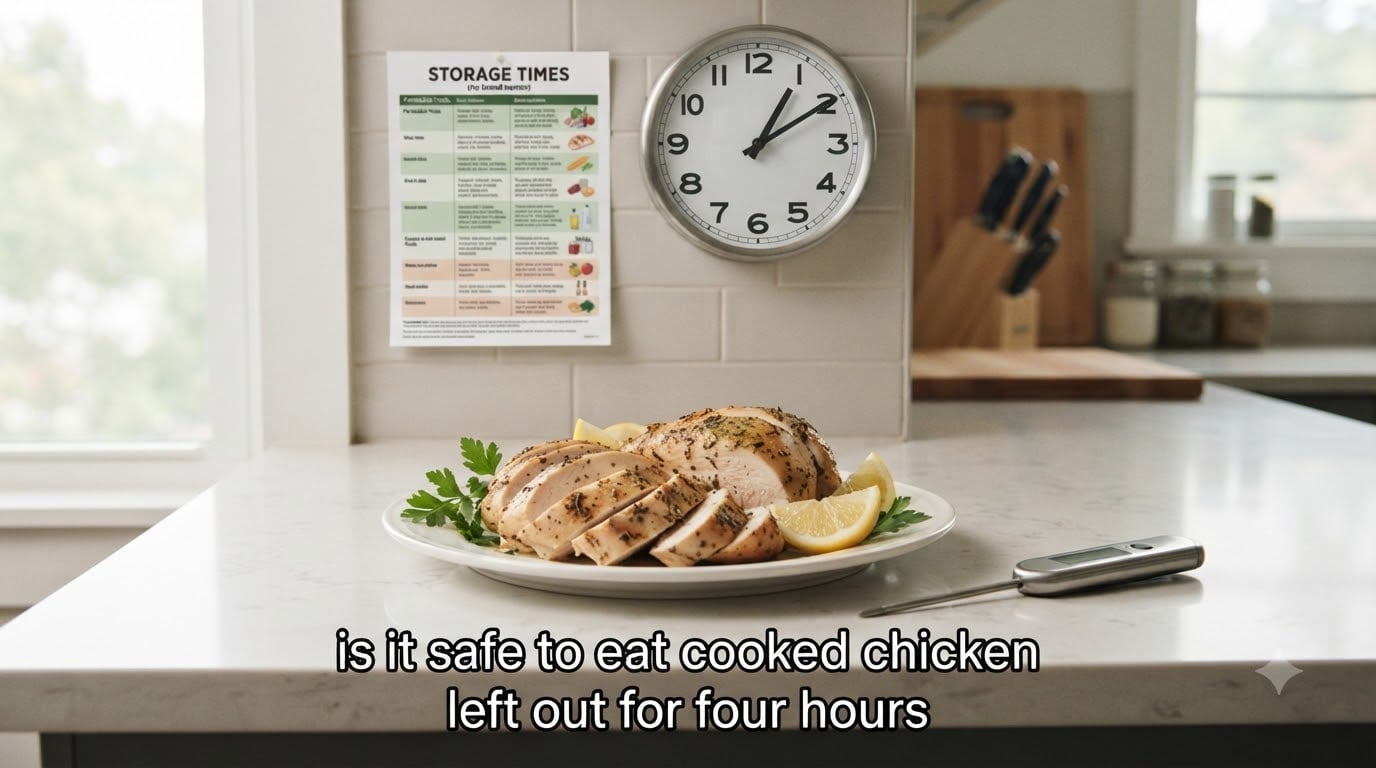
No, it is not safe to eat cooked chicken left out for four hours. According to the USDA, cooked poultry should never sit at room temperature for more than 2 hours — or just 1 hour if the ambient temperature exceeds 90°F. At the 4-hour mark, bacterial populations in that chicken have had enough time to multiply to dangerous levels, producing toxins that reheating cannot destroy.
I know this answer stings when you are staring at a tray of perfectly good-looking chicken wings you forgot on the counter after last night’s dinner party. We have all been there. But understanding why the 2-hour rule exists — and what actually happens inside that chicken during those extra hours — can save you from a miserable bout of foodborne illness.
In this guide, I will walk you through the science behind the USDA guidelines, explain which bacteria are the real culprits, and cover what to do if you have already eaten chicken that was sitting out too long. Whether your chicken was left out at a barbecue, on the kitchen counter overnight, or in a takeout container for hours, here is everything you need to know to stay safe.
Table of Contents
The USDA 2-Hour Rule: The Official Guideline
The USDA’s 2-hour rule is the single most important food safety guideline for perishable foods. It states that any cooked food — including chicken — should not remain at room temperature for more than 2 hours total. That window shrinks to just 1 hour when the ambient temperature is above 90°F, which is common at outdoor barbecues, picnics, and summer parties.
These are not suggestions. They are based on decades of food safety research conducted by the USDA’s Food Safety and Inspection Service (FSIS). The rule accounts for the fact that bacteria thrive in warm, moist, protein-rich environments — exactly the conditions cooked chicken provides.
A critical detail many people miss: the 2-hour limit is cumulative. If your chicken sat out for 90 minutes during dinner, went back to the fridge, and then sat out for another 45 minutes the next day, it has already exceeded the safe window. Time does not reset just because you refrigerated it in between.
What Is the Temperature Danger Zone?
The temperature danger zone is the range between 40°F and 140°F (4°C and 60°C) where bacteria multiply most rapidly. Room temperature — typically around 68°F to 72°F — falls squarely in the middle of this zone. Cooked chicken sitting on a countertop is essentially inside a bacterial incubator.
At these temperatures, harmful bacteria can double their population every 20 minutes under ideal conditions. That means a single bacterium can become over 65,000 in just 4 hours. Most food safety authorities consider 100,000 bacteria per gram to be the threshold for illness — and chicken left out for 4 hours can easily approach or exceed that number.
Here is how the danger zone breaks down:
- Below 40°F (4°C): Bacterial growth slows dramatically. This is why refrigeration works.
- 40°F to 140°F (4°C to 60°C): The danger zone. Bacteria multiply rapidly. The 2-hour rule applies here.
- Above 140°F (60°C): Most bacteria are killed or stopped. Hot holding at this temperature keeps food safe.
- Above 90°F (32°C) ambient: Bacteria grow even faster. The safe window drops to just 1 hour.
What Bacteria Grow in Cooked Chicken Left Out?
Cooked chicken left at room temperature does not grow just any bacteria — it grows the ones most likely to make you seriously ill. Understanding the specific pathogens helps explain why the rules exist and why reheating does not always save the food.
Staphylococcus aureus is the most concerning. This bacterium produces enterotoxins — poisons that are heat-stable, meaning they survive temperatures well above boiling. Even if you reheat chicken to 165°F, the toxins S. aureus has already produced remain active and can cause nausea, vomiting, and diarrhea within 1 to 6 hours of ingestion.
Salmonella is another major risk. While Salmonella bacteria themselves are killed by proper reheating to 165°F, the problem is that by the time you reheat chicken that has been out for 4 hours, the bacterial load may be so high that even trace survivors can cause infection. Salmonella symptoms typically appear 6 to 72 hours after eating contaminated food.
Clostridium perfringens is sometimes called the “cafeteria germ” because it thrives in large batches of food kept warm — but not warm enough. It produces spores that germinate when food cools slowly and sits in the danger zone. Symptoms (mainly diarrhea and abdominal cramps) usually appear 6 to 24 hours after eating.
Bacillus cereus can also be present, especially in chicken dishes that include rice or starch. Its heat-resistant spores survive cooking and can produce emetic toxins at room temperature.
Why Reheating Does Not Make Left-Out Chicken Safe
This is the single most dangerous misconception about food safety, and it comes up constantly in online discussions. Many people believe that if they reheat chicken to 165°F, any bacteria that grew during time at room temperature will be killed, making the food safe again. That belief is partially true — and that is what makes it so dangerous.
Reheating to 165°F will kill most living bacteria, including Salmonella, C. perfringens vegetative cells, and most S. aureus cells. However, some bacteria — particularly S. aureus — produce toxins before they are killed. These toxins are heat-stable, meaning they can withstand temperatures of 250°F or higher without breaking down. No amount of reheating will neutralize them.
Think of it this way: the bacteria are the factory, and the toxins are the poison they manufactured. Killing the factory worker (the bacterium) does not un-make the poison. Once those toxins are in the chicken, they stay there no matter how hot you cook it.
Additionally, C. perfringens and B. cereus form spores that are extremely resistant to heat. Even thorough reheating may leave viable spores behind that can germinate and multiply again if the food cools down.
Is It Safe to Eat Cooked Chicken Left Out for Four Hours? Quick Reference
Here is a straightforward reference table based on USDA guidelines. Use this to quickly determine whether your chicken is still safe:
| Time at Room Temperature | Ambient Below 90°F | Ambient Above 90°F |
|---|---|---|
| Under 1 hour | Safe — refrigerate promptly | Safe — refrigerate promptly |
| 1 to 2 hours | Safe — refrigerate or eat immediately | Discard |
| 2 to 4 hours | Discard | Discard |
| Over 4 hours | Discard — toxin risk is high | Discard — toxin risk is high |
At the 4-hour mark, even if the chicken looks and smells fine, bacterial populations have had ample time to produce dangerous levels of toxins. The USDA is unambiguous: discard it. There is no safe way to salvage chicken that has been in the danger zone for 4 hours or more.
How Bacteria Multiply: The Exponential Growth Problem
One reason the 2-hour rule matters so much is that bacteria do not grow linearly — they grow exponentially. Under ideal conditions in the temperature danger zone, many pathogenic bacteria double their population every 20 minutes.
Here is what that looks like in practice, starting from just 1 bacterium on a piece of cooked chicken:
- 0 minutes: 1 bacterium
- 20 minutes: 2 bacteria
- 1 hour: 8 bacteria
- 2 hours: 64 bacteria
- 3 hours: 512 bacteria
- 4 hours: 4,096 bacteria
- 6 hours: 262,144 bacteria
In real-world conditions, bacterial growth may not follow this math perfectly — food composition, moisture levels, and competing microorganisms all play a role. But the underlying principle holds: time in the danger zone is not your friend. Every additional 20 minutes roughly doubles the risk.
After 4 hours, even starting from a small initial contamination, bacterial counts can reach levels that overwhelm your immune system and produce enough toxins to cause illness.
What to Do If You Already Ate Chicken Left Out Too Long
This is the question nobody’s favorite food safety article answers, but it is the one people are actually searching for. If you have already consumed chicken that was sitting out for 4 hours or longer, here is what you need to know.
Do not panic. Not everyone who eats chicken left out too long will get sick. The risk depends on the specific bacteria present, the bacterial load, your individual immune system, and how much you ate. Many people have eaten questionable chicken without incident — that is called survivorship bias, and it does not mean the risk was zero.
Monitor for symptoms. Foodborne illness symptoms vary by pathogen, but here is a general timeline:
- 1 to 6 hours: Nausea, vomiting, and stomach cramps (suggestive of S. aureus toxins or B. cereus)
- 6 to 24 hours: Diarrhea and abdominal cramps without vomiting (suggestive of C. perfringens)
- 6 to 72 hours: Diarrhea, fever, and stomach cramps (suggestive of Salmonella)
Stay hydrated. If symptoms develop, the biggest risk is dehydration from vomiting and diarrhea. Sip clear fluids, oral rehydration solutions, or electrolyte drinks. Avoid dairy, caffeine, and alcohol until symptoms resolve.
Seek medical attention if:
- You have a fever above 101.5°F (38.6°C)
- Bloody stools or severe abdominal pain
- Symptoms persisting more than 48 hours
- Signs of severe dehydration (dizziness, dry mouth, dark urine, rapid heartbeat)
- You are in a high-risk group: pregnant, elderly, immunocompromised, or a child under 5
Most cases of foodborne illness from chicken resolve on their own within 24 to 48 hours. But in vulnerable populations, Salmonella infections can become serious and require medical treatment.
Signs That Cooked Chicken Has Gone Bad
While visual and smell cues can help identify spoiled chicken, there is an important caveat: chicken that looks and smells normal can still be unsafe. The toxins produced by S. aureus, for example, are odorless and colorless. You cannot see, smell, or taste them.
That said, here are the signs that cooked chicken has definitely gone bad:
- Slimy or sticky texture: Fresh cooked chicken should feel firm and dry to the touch. A slippery or tacky film on the surface indicates bacterial growth.
- Off smell: A sour, ammonia-like, or sulfur odor is a clear indicator of spoilage bacteria at work. Trust your nose — if it smells wrong, it is wrong.
- Color changes: Cooked chicken that turns gray, green, or develops dark spots has undergone significant bacterial decomposition.
- Mold: Any visible mold growth means the chicken should be discarded immediately. Mold can produce mycotoxins that are harmful even in small amounts.
The absence of these signs does not make chicken safe. Pathogenic bacteria like S. aureus can produce dangerous levels of toxins without causing any visible or olfactory changes to the food. Always rely on the 2-hour rule, not your senses.
How to Safely Store Cooked Chicken
Proper storage is the best way to keep cooked chicken safe and avoid the “was this out too long?” dilemma. Here is how to do it right.
Cool it quickly. The USDA recommends refrigerating cooked chicken within 2 hours of cooking. To speed up cooling, divide large batches into shallow containers no deeper than 2 inches. This allows the chicken to cool evenly and pass through the danger zone faster.
Do not wait for it to reach room temperature. A common mistake is leaving cooked chicken on the counter until it “cools down enough” for the fridge. Modern refrigerators can handle warm food without issues. Get that chicken into the fridge as soon as possible.
Use airtight containers. Store cooked chicken in sealed, airtight containers to prevent cross-contamination with other foods and to slow bacterial growth by limiting oxygen exposure.
Follow these storage timeframes:
| Storage Method | Temperature | Safe Duration |
|---|---|---|
| Countertop / Room temp | 68-72°F (20-22°C) | 2 hours maximum |
| Refrigerator | 40°F (4°C) or below | 3 to 4 days |
| Freezer | 0°F (-18°C) or below | 2 to 6 months (best quality) |
Reheat to 165°F. When you are ready to eat refrigerated leftover chicken, always reheat it to an internal temperature of 165°F (74°C). Use a food thermometer to verify — do not guess. This kills any bacteria that may have grown during proper refrigeration (but remember, it does not eliminate toxins if the chicken was previously left out too long).
Frequently Asked Questions
Can you eat cooked chicken left out for 4 hours?
No, you should not eat cooked chicken that has been left out for 4 hours. The USDA’s 2-hour rule states that perishable food should not sit at room temperature for more than 2 hours. At the 4-hour mark, harmful bacteria like Staphylococcus aureus may have produced heat-stable toxins that reheating cannot destroy.
Is cooked meat safe to eat if left out for 4 hours?
No, cooked meat left out for 4 hours has exceeded the USDA’s safe time limit by 2 hours. Bacteria in the temperature danger zone (40°F to 140°F) can double every 20 minutes, meaning bacterial counts may have reached dangerous levels. The USDA recommends discarding any cooked meat left out for more than 2 hours.
What does the 2-hour/4-hour rule mean for food safety?
The 2-hour rule is a USDA guideline stating that perishable foods like cooked chicken should not remain at room temperature for more than 2 hours total. In temperatures above 90°F, this window drops to 1 hour. The 4-hour threshold is a hard cutoff — after 4 hours in the danger zone, bacterial toxin production is likely high enough to cause illness even if the food is reheated.
Can I eat chicken that was left outside for 5 hours?
No, chicken left outside for 5 hours should be discarded. It has been in the temperature danger zone for more than double the safe limit. Bacterial populations and their toxins have likely reached dangerous levels that no amount of reheating can fix.
Does reheating chicken left out overnight make it safe?
No, reheating does not make chicken safe if it was left out overnight. While reheating to 165°F kills most living bacteria, it does not destroy the heat-stable toxins produced by bacteria like Staphylococcus aureus during the hours the chicken spent in the danger zone. These toxins can still cause foodborne illness.
Is chicken left out in a sealed container safer?
A sealed container slows bacterial growth somewhat by limiting oxygen exposure, but it does not make chicken safe beyond the 2-hour window. The USDA’s time limits apply regardless of whether the container is sealed or open. Sealed chicken left out for 4 hours should still be discarded.
Will I get sick from eating chicken left out 4 hours?
Not necessarily — the risk depends on the specific bacteria present, bacterial load, and your individual immune system. However, the risk is real and significant. Symptoms of foodborne illness from chicken can include nausea, vomiting, diarrhea, and stomach cramps, appearing anywhere from 1 to 72 hours after consumption. If you experience severe symptoms, seek medical attention.
So, is it safe to eat cooked chicken left out for four hours? The answer is clear: no. The USDA’s 2-hour rule exists for a reason, and at the 4-hour mark, you have doubled the safe window and entered territory where heat-stable toxins may be present. Toss the chicken, learn the storage guidelines above, and keep a food thermometer in your kitchen drawer. Your stomach will thank you.