
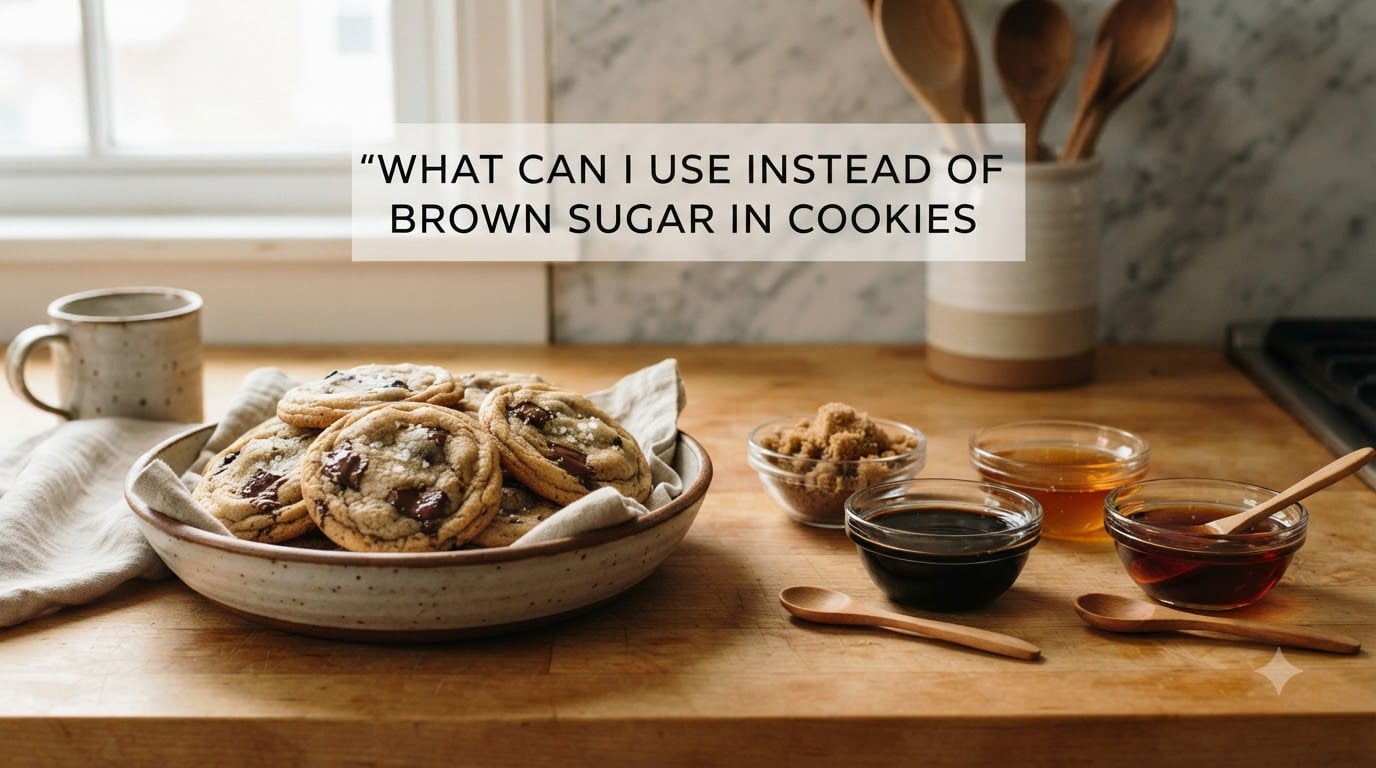
You’ve hit the “brown sugar needed” line in your favorite cookie recipe, and there’s nothing in the pantry. I have been there more times than I can count, so let me save you the panic: you can absolutely still make great cookies without brown sugar. This guide covers everything you need to know about what can I use instead of brown sugar in cookies, from the closest 1:1 swap to pantry-only fallbacks.
Brown sugar is just white sugar with molasses added back in, so any substitute that delivers moisture, a hint of acid, and that warm butterscotch flavor will get you close. Below are seven tested substitutes, the exact ratios, and how each one affects your cookies. If you are mid-recipe, scroll straight to the quick list.
Table of Contents
What Can I Use Instead of Brown Sugar in Cookies?
- White sugar + molasses — The closest 1:1 swap. Use 1 cup white sugar plus 1-2 tablespoons of molasses.
- Honey — Cuts liquid elsewhere; lowers oven temp by about 25°F to prevent burning.
- Maple syrup — Liquid sweetener with a distinct flavor; reduces other liquid by roughly 3 tablespoons per cup.
- Coconut sugar — A 1:1 swap by volume with a caramel taste and slightly drier texture.
- Muscovado sugar — A 1:1 swap with deeper molasses flavor and denser cookies.
- Demerara or turbinado sugar — Larger crystals; slightly less moisture but works as a 1:1 swap.
- Date sugar — 1:1 swap with fruity sweetness; cookies come out drier.
Each of these is covered in detail below, including how to adjust your recipe to keep texture and flavor on point.
Why Brown Sugar Matters in Cookies
Brown sugar is white granulated sugar with added molasses — usually 3.5% for light brown and 6.5% for dark brown. That molasses is doing three things at once in your dough: holding onto moisture, acidifying the batter, and delivering caramel-like flavor.
Moisture. Molasses is hygroscopic, which means it attracts and holds water. Cookies made with brown sugar stay chewy for days because the dough retains moisture during baking and beyond.
Acidity. Molasses has a pH around 5.5, which is mildly acidic. When you use brown sugar with baking soda, the acid activates the soda to create carbon dioxide, giving your cookies a better rise and a softer interior crumb.
Flavor. Molasses carries the deep, warm, butterscotch notes that make cookies taste like more than just sweet. Maillard reactions between the sugars and proteins create browning and complex flavor during baking.
If your substitute delivers all three — moisture, acid, and flavor — your cookies will be nearly identical to the original. Most substitutes deliver two of the three and trade off the third. Knowing which one you are losing tells you what to expect.
White Sugar + Molasses: The Closest 1:1 Substitute
If you have white sugar and a jar of molasses in the back of the cupboard, stop looking. This is the gold standard swap, and it is what professional bakers reach for when they run out of brown sugar.
For light brown sugar: Mix 1 cup (200g) of white granulated sugar with 1 tablespoon of molasses. Stir until the molasses is evenly distributed.
For dark brown sugar: Mix 1 cup of white granulated sugar with 2 tablespoons of molasses. The extra molasses gives you the deeper color and richer flavor of dark brown.
For best results, sift the two together a couple of times rather than stirring. The finer the molasses is distributed, the closer your cookies will be to the real thing.
Texture-wise, you can expect nearly identical results: chewy centers, slightly crisp edges, and that signature butterscotch flavor. I tested this in chocolate chip cookies and the tasters could not tell the difference.
Other Brown Sugar Substitutes for Cookies
If you don’t have molasses — or you want to try something different — here are the substitutes I recommend, ranked by how close they get you to the original.
Honey
Honey is roughly 1.5 times sweeter than sugar and brings about 3 tablespoons of liquid per cup. Replace 1 cup of brown sugar with 2/3 cup honey, then reduce other liquid in your recipe by 3 tablespoons.
Also drop your oven temperature by about 25°F (about 15°C) because honey browns faster than sugar. The result is a softer cookie with a floral sweetness. Honey works especially well in snickerdoodles and oatmeal cookies.
Maple Syrup
Maple syrup is similar to honey in behavior: a liquid sweetener that needs a 3-4 tablespoon liquid reduction per cup. Replace 1 cup of brown sugar with 3/4 cup maple syrup and cut liquid elsewhere in the recipe.
Expect a noticeably maple-forward flavor and thinner cookies that spread more during baking. I love maple syrup in oatmeal raisin cookies, where its flavor echoes the spices. Pure maple syrup is best — pancake syrup will leave a fake aftertaste.
Coconut Sugar
Coconut sugar is a 1:1 swap by volume, but it behaves slightly differently in the oven. It absorbs a bit more liquid, so your cookies will turn out drier and a touch crumblier.
The flavor is caramel-like and slightly less sweet than cane sugar. Coconut sugar is the favorite swap for gingerbread and spice cookies, where the warm flavor complements cinnamon and molasses spices. Cookies will bake a bit darker, so check them a couple of minutes earlier than the recipe states.
Muscovado Sugar
Muscovado is unrefined cane sugar with all of its molasses left in — which means it is essentially a more intense version of dark brown sugar. It swaps 1:1 by volume.
Your cookies will be denser, chewier, and stronger in molasses flavor. If your recipe already calls for dark brown sugar, muscovado is a perfect substitute. If the recipe uses light brown sugar, your cookies will taste richer than intended — which is rarely a problem.
Demerara and Turbinado Sugar
Demerara and turbinado are partially refined sugars with larger crystals and a light molasses coating. They swap 1:1 by volume but bring less moisture and a slight crunch.
Cookies come out with crispier edges and a subtle caramel note. They work well in shortbread and snickerdoodles, where the texture contrast is welcome. They are not the best pick for chewy chocolate chip cookies, where the moisture loss is felt.
Date Sugar
Date sugar is made from dehydrated dates ground into a powder. It is a 1:1 swap by volume but does not dissolve into dough the way regular sugar does — you will see little flecks.
The flavor is fruity and mildly sweet, and your cookies will be noticeably drier. Date sugar is popular in health-conscious baking and pairs nicely with whole-grain cookies. Be aware that it burns faster than cane sugar, so lower your oven temp by 25°F.
How to Make Brown Sugar at Home
If you have white sugar and molasses, you can make brown sugar in about two minutes. This is the rescue recipe every baker should have memorized.
Ingredients:
- 1 cup (200g) white granulated sugar
- 1 tablespoon molasses for light brown, or 2 tablespoons for dark brown
Instructions:
- Measure the white sugar into a bowl.
- Add the molasses.
- Stir with a fork until the molasses is evenly distributed. Sifting twice helps.
- Use immediately, or store in an airtight container.
The homemade version is functionally identical to store-bought brown sugar. If your brown sugar has hardened into a brick, you can soften it by placing a slice of bread in the bag overnight, or by microwaving it in 10-second bursts with a damp paper towel on top. If it smells off or has hardened beyond recovery, your DIY recipe is faster than running to the store.
Substitution Tips for Perfect Cookies
Substituting brown sugar is rarely as simple as a one-for-one swap. Here are the four adjustments I make every time I change sweeteners.
Liquid adjustment: Honey and maple syrup add liquid, so cut 3-4 tablespoons of water, milk, or egg from somewhere else in the recipe. Coconut sugar and date sugar absorb liquid, so you may need to add 1-2 tablespoons of liquid.
Oven temperature: Honey, maple syrup, and date sugar brown faster than cane sugar. Lower your oven by 25°F (about 15°C) and check the cookies 2-3 minutes earlier than the recipe says.
Leavening: Brown sugar’s acid reacts with baking soda. If you switch to white sugar alone, your cookies will spread more and rise less. Adding 1/4 teaspoon of cream of tartar or a teaspoon of lemon juice per cup of sugar restores the acid.
Expect the texture to shift. Every substitute changes your cookies a little. White sugar alone gives crispier, paler cookies. Honey gives softer, denser cookies. Muscovado gives the chewiest cookies of any substitute. None of these are wrong — they are just different cookies.
Best Substitutes by Cookie Type
Different cookies tolerate different substitutes. Here is my go-to list when I know which recipe I am making.
Chocolate chip cookies: White sugar plus molasses is the closest match. Honey works if you want a softer cookie. Maple syrup adds a nice flavor twist but expect more spread.
Snickerdoodles: These need the acid from brown sugar to activate the cream of tartar. White sugar plus molasses works perfectly. Coconut sugar is a decent swap if you add a teaspoon of cream of tartar to compensate for the missing acid.
Gingerbread cookies: Gingerbread already uses molasses, so coconut sugar or muscovado are excellent swaps. They deepen the spice profile rather than fighting it.
Oatmeal cookies: The most forgiving recipe. Honey, maple syrup, coconut sugar, or muscovado all work well. I default to honey for the softest texture.
Shortbread: Demerara or turbinado sugar adds the perfect crunch to shortbread’s melt-in-your-mouth base.
Sugar-Free and Diabetic-Friendly Options
If you need a sugar-free swap, the choices are more limited. Most non-caloric sweeteners lack the moisture and browning of cane sugar.
Monk fruit sweetener is the best option for cookies. It browns reasonably well and has a clean sweetness. Use a 1:1 baking blend that includes erythritol to balance the texture.
Erythritol swaps 1:1 by volume but does not caramelize the same way. Your cookies will be paler and may have a cooling aftertaste. Blending erythritol with a small amount of molasses or maple extract helps bring back some of the lost flavor.
Stevia-based baking blends work but require adjustment. The blends include bulking agents like erythritol or inulin, so follow the package directions for ratio. Expect different texture and limited browning.
Sugar-free cookies will never look or taste identical to sugar cookies, but with the right blend, they are very close. If you are diabetic or following a low-carb plan, look for blends specifically labeled “golden” or “brown” — these have added molasses flavor and color.
Frequently Asked Questions
Can I use white sugar instead of brown sugar in cookies?
Yes, but the cookies will be paler, crispier, and less chewy. For the closest 1:1 swap, mix 1 cup of white sugar with 1 tablespoon of molasses for light brown, or 2 tablespoons for dark brown.
What happens if you use white sugar instead of brown sugar in cookies?
Cookies will spread more, rise less, and lose their chewy texture and butterscotch flavor. Brown sugar’s molasses provides moisture, acidity, and flavor — white sugar provides none of the three.
Can I use honey instead of brown sugar in cookies?
Yes. Use 2/3 cup honey for every 1 cup of brown sugar, reduce other liquid by 3 tablespoons, and lower oven temperature by about 25°F. Expect softer cookies with a floral sweetness.
Can you use maple syrup instead of brown sugar in cookies?
Yes. Replace 1 cup of brown sugar with 3/4 cup maple syrup, reduce other liquid by 3-4 tablespoons, and lower the oven by 25°F. Cookies will be thinner and have a noticeable maple flavor.
How do you make brown sugar at home?
Mix 1 cup of white granulated sugar with 1 tablespoon of molasses for light brown sugar, or 2 tablespoons for dark brown. Stir well or sift twice for even distribution.
Can you use coconut sugar instead of brown sugar in cookies?
Yes, coconut sugar is a 1:1 swap by volume. The cookies will be slightly drier and crumblier with a darker color and caramel-like flavor. Coconut sugar works especially well in gingerbread and spice cookies.
What can I use if I don’t have brown sugar or molasses?
Your best pantry-only fallback is honey or maple syrup, with a 3-4 tablespoon reduction in the recipe’s other liquids and a 25°F drop in oven temperature. Coconut sugar works if you have it, though cookies will be drier.
Conclusion
Running out of brown sugar mid-recipe is not the disaster it feels like. Whether you have white sugar and molasses, just honey, or only coconut sugar in the back of the pantry, there is a swap that will get you to a tray of good cookies.
The closest 1:1 substitute for brown sugar in cookies is always white granulated sugar plus 1-2 tablespoons of molasses per cup. If you do not have molasses, honey and maple syrup are the next best options — just remember to cut the other liquids in the recipe and lower your oven temperature by about 25°F. Coconut sugar, muscovado, and date sugar are excellent alternatives that work especially well in spiced or whole-grain cookies.
For most cookie recipes, this guide answers what can I use instead of brown sugar in cookies with options for every pantry. Pick the swap that matches what you have on hand, follow the ratio and temperature adjustments, and you will end up with cookies worth baking.