
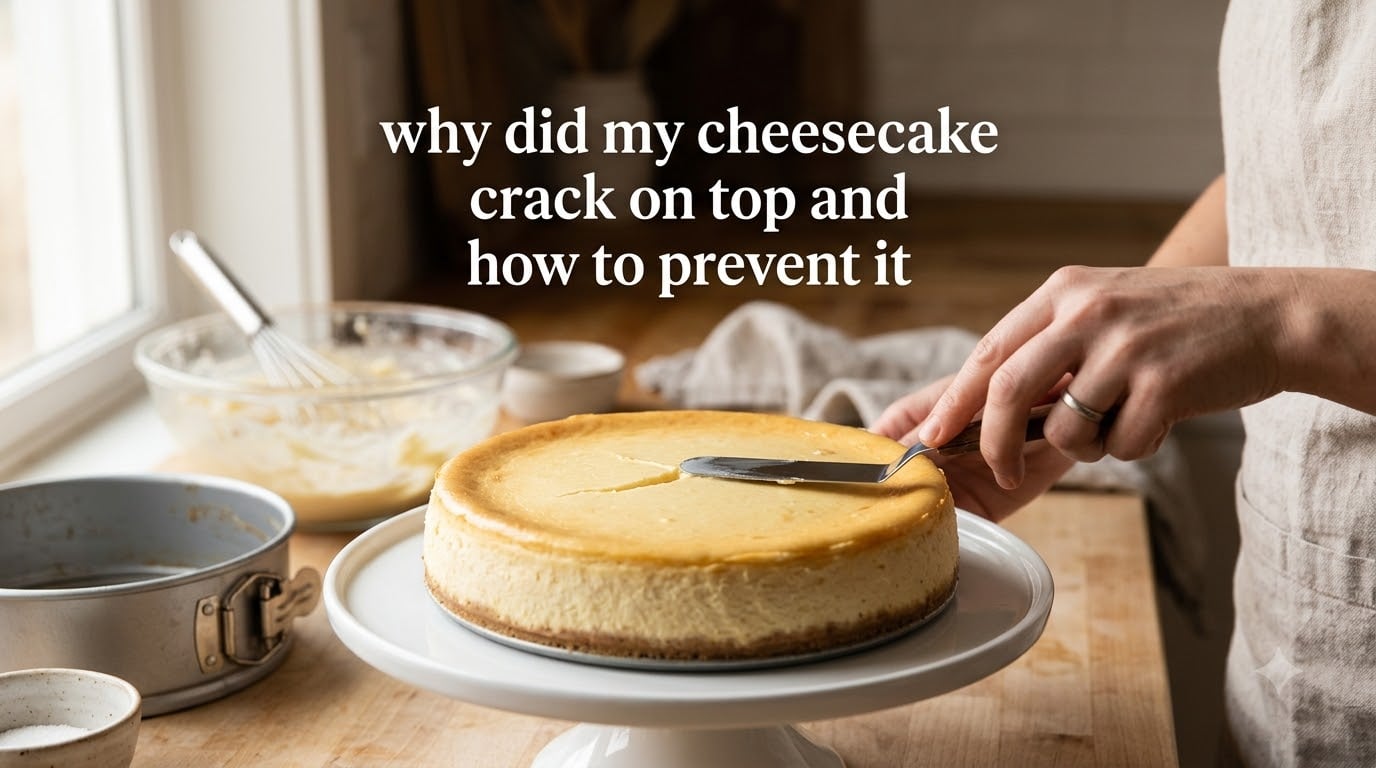
A cheesecake cracks on top for three main reasons: it was overbaked, the batter was overmixed and trapped too much air, or it cooled too quickly and shrank faster than its surface could stretch. In every case, the delicate egg-custard filling contracted more than the top layer could handle, so the surface split.
If you opened the oven to find a crack down the middle of your cheesecake, you’re in good company. I’ve pulled more than my share of cracked cheesecakes out of the oven, and so have the home bakers in our test kitchen. A crack is almost always a sign of one of three things, and each one is fixable.
In this guide, I’ll walk you through the five most common causes of cracking, a 10-step prevention checklist our team uses for crack-free results, and three reliable ways to fix a cheesecake that has already cracked. You’ll also get answers to the 12 questions Google shows most often for this problem, including the puzzling one about cracks that show up overnight in the fridge.
Table of Contents
Quick Diagnosis: What Your Crack Is Telling You
Before we dive into causes, run your eye over the table below. The way a cheesecake cracked usually points to a specific mistake, so matching the symptom to the cause is the fastest way to fix the problem next time.
| What the Crack Looks Like | Most Likely Cause | Quick Fix |
|---|---|---|
| One big crack down the center | Overbaked or cooled too fast | Pull earlier next time, cool in the oven with door cracked |
| Many small cracks across the top | Batter overmixed, air bubbles rose | Mix eggs in one at a time on low speed, tap the pan |
| Crack appeared hours later (overnight) | Residual shrinkage during slow cooling | Cool 1 hour in oven, then 1 hour on counter, then fridge |
| Crack + soggy or rubbery crust | Water bath leaked into the pan | Double-wrap springform in heavy-duty foil |
| Crack + browned top, raw center | Oven too hot | Drop to 300-325°F, use a thermometer |
| Surface cracked but inside is fine | Dry oven, no humidity | Use a water bath or place a pan of hot water on lower rack |
Once you’ve matched your crack, the sections below explain the science behind each cause and exactly what to change.
The 5 Main Causes of Cheesecake Cracking
Every cracked cheesecake I’ve diagnosed in our test kitchen has come down to one of these five issues. Most cheesecakes crack because of a combination, so don’t be surprised if you see yourself in more than one.
1. Overbaking (the most common cause)
Overbaking is the single biggest reason cheesecakes crack. The custard is supposed to set gently around 150°F in the center and 170-175°F at the edge. Push past those numbers and the proteins tighten, the moisture evaporates, and the top dries out before the inside finishes. As the cheesecake cools, the dry top can’t stretch to accommodate the shrinking filling underneath, so it splits.
A cracked cheesecake from overbaking almost always has a deep golden-brown top and slightly puffed edges. If your cheesecake is brown on top but jiggly in the middle, the oven was too hot or it baked too long. Drop your temperature to 300-325°F and start checking 10 minutes before the recipe’s minimum bake time.
2. Overmixing and trapped air bubbles
Eggs hold air. Beat them too vigorously, especially on high speed, and you whip thousands of tiny air pockets into the batter. Those pockets rise as the cheesecake bakes, the surface stretches to follow them, and when the air escapes or the cheesecake settles, the surface tears.
You’ll recognize an overmixed cheesecake by lots of small cracks across the top, almost like a dried riverbed, or by a puffed, soufflé-like surface that collapses as it cools. Mix cream cheese on medium until smooth, then add eggs one at a time on low speed. Stop the moment each egg disappears. Tap the filled pan firmly on the counter 5-6 times before baking to pop large air bubbles.
3. Temperature shock during cooling
Pulling a hot cheesecake out of the oven into a cool kitchen is a recipe for a crack. The outside cools and contracts much faster than the inside, which is still warm and expanded. That uneven contraction tears the surface.
Reddit bakers describe this as the cheesecake “screaming in the cold air.” The fix is to leave the cheesecake in the oven with the door cracked for one full hour, then move it to the counter for another hour before refrigerating. The slow, even cooldown lets the entire cake shrink together without splitting.
4. Residual shrinkage (cracking hours later)
This is the one nobody warns you about, and it’s why so many bakers on r/Baking report that their cheesecake cracked overnight in the fridge even though it looked perfect coming out of the oven. As the cheesecake continues to set in the refrigerator, the proteins contract a little more. If the surface has already dried from overbaking or low humidity, it can’t flex with that final shrinkage, and a crack appears hours after baking.
The solution is a slow, staged cool-down plus a humid bake. Wrap the pan in foil, set it in a water bath, and bake at 300-325°F. Cool in the oven with the door ajar, then on the counter, then chill. Cheesecakes made this way rarely develop the overnight crack.
5. Dry oven environment (no water bath)
A dry oven dries out the top of the cheesecake while it’s baking, which is the same mechanism as overbaking. A water bath – called a bain-marie in professional kitchens – surrounds the springform pan with steam, keeping the surface supple and flexible. Without that humidity, the top firms up too early and cracks as the filling sets.
If you’ve ever wondered why restaurant cheesecakes look so smooth, this is the secret. Cheesecakes without a water bath can still come out fine in a steam-injection oven or with a pan of boiling water on the lower rack, but a true bain-marie is the most reliable method.
How to Prevent Cheesecake Cracks: 10-Step Checklist
This is the checklist our team runs through before every cheesecake bake. Follow all ten and you’ll get a smooth, crack-free top nearly every time.
- Bring all ingredients to room temperature. Cold cream cheese won’t blend smoothly and forces you to overmix. Set blocks out 1-2 hours ahead.
- Beat cream cheese on medium until smooth, then add sugar. Don’t go above medium speed.
- Add eggs one at a time on low speed. Stop as soon as each egg disappears. Scrape the bowl between eggs.
- Fold in sour cream and heavy cream by hand. No more mixer action once the dairy goes in.
- Tap the filled pan on the counter 5-6 times. This pops large air bubbles that would otherwise rise and crack the top.
- Double-wrap the springform pan in heavy-duty foil. Regular foil can tear. A leak ruins the crust.
- Set the wrapped pan in a roasting pan and add 1 inch of hot water. This is your water bath.
- Bake at 300-325°F for 50-70 minutes. Pull when the edges are set but the center 2-inch circle still jiggles.
- Check internal temperature: 150°F in the center, 170-175°F at the edge. A digital thermometer takes the guesswork out.
- Cool in the oven with the door cracked for 1 hour, then on the counter for 1 hour, then refrigerate. The slow cool prevents overnight cracks.
Two of those steps deserve extra detail because they make the biggest difference.
Setting up a water bath that doesn’t leak
The bain-marie is the single best crack prevention technique, but only if the water stays outside the pan. Tear a sheet of heavy-duty aluminum foil – the kind labeled “heavy duty” – and press it up the sides of the springform pan. Wrap a second sheet in the opposite direction. Pour your batter in, then set the wrapped pan inside a larger roasting pan. Add hot water until it reaches about 1 inch up the outside of the springform.
Some bakers on Sally’s Baking Addiction report success using an oven bag instead of foil, which is worth trying if your springform is particularly stubborn about leaking.
The jiggle + thermometer doneness test
The jiggle test is what most home bakers use: nudge the pan and look at the center. The edges should be set and the middle 2 inches should wobble like firm Jell-O. If the whole surface ripples like liquid, it needs more time.
For more precision, slide a digital thermometer into the center. You’re aiming for 150°F in the middle and 170-175°F at the edge. The center will continue to climb 5-10°F as it cools, so pull at 150°F and trust the carryover. This is the single most accurate way to avoid the overbake-crack cycle.
How to Fix a Cracked Cheesecake (3 Methods)
If your cheesecake has already cracked, don’t toss it. A crack is cosmetic, not a flavor failure, and there are three reliable ways to rescue the presentation.
Method 1: Melt it back with a hot spoon
This is the technique professional pastry chefs use. Dip a spoon or small offset spatula in very hot water, dry it off, and gently press the warm metal along the crack. The residual heat softens the surface just enough that the edges melt together and the crack disappears. Work slowly, reheating the spoon every few strokes. It’s not magic – patience is the real ingredient.
Method 2: Cover it with a topping
Cracks hide beautifully under any of these:
- Sour cream topping: Mix 1 cup sour cream, 2 tablespoons sugar, 1 teaspoon vanilla. Spread over the chilled cheesecake. Classic New York style.
- Whipped cream: Pile soft peaks over the entire surface and the crack vanishes.
- Chocolate ganache: Pour warm ganache over the top and let it self-level.
- Lemon curd or fruit sauce: Spoon over and let gravity do the work.
- Fresh berries: Arrange in concentric circles to draw the eye away from any remaining marks.
Method 3: Repurpose it
If the crack is too deep or the top looks beyond saving, the cheesecake is still delicious. Crumble it into parfait glasses with whipped cream and berries, roll into truffles coated in melted chocolate, layer into a trifle, or press into a no-bake cheesecake pie crust. A cracked cheesecake tastes exactly like a smooth one – your guests will never know.
Frequently Asked Questions
Why did my baked cheesecake crack on top?
Cheesecakes crack on top for three main reasons: overbaking, which dries out the surface before the inside is set; overmixing, which traps air that rises and breaks the surface as it bakes; or sudden temperature change during cooling, which causes the outside to contract faster than the inside. Slow baking with a water bath and a gradual cool-down prevents all three.
How to keep the top of a cheesecake from cracking?
Use a water bath (bain-marie), bake at 300-325°F instead of 350°F, mix eggs in one at a time on low speed, and cool the cheesecake in the oven with the door cracked for one hour before moving it to the counter and then the fridge.
How to fix crack on cheesecake?
Three reliable methods: melt the crack back together using a spoon or offset spatula dipped in very hot water, cover the entire top with whipped cream, sour cream topping, ganache, or fresh berries, or repurpose the cheesecake into parfaits, truffles, or a trifle.
Is my cheesecake ruined if it cracks?
No. A crack is purely cosmetic – it does not affect flavor or food safety. Cover it with a topping, melt it back with a hot spoon, or repurpose the cake into another dessert. A cracked cheesecake still tastes exactly like a smooth one.
How to keep a cheesecake from cracking without a water bath?
Place a metal or oven-safe pan on the lower rack while the oven preheats, then pour 2-3 cups of boiling water into it just before sliding the cheesecake in. This creates a humid steam environment similar to a water bath. You can also bake at 300°F, mix gently, and cool gradually.
If cheesecake cracks, does it mean it’s overcooked?
Often yes. Overbaking is the most common cause of cracking because the surface dries and tightens before the center finishes. However, cracks can also come from overmixing, cooling too quickly, or a dry oven environment. Check for a deep golden top combined with a crack to confirm overbaking.
Will my cheesecake still be good if it cracks?
Yes. A cracked cheesecake is just as creamy, rich, and delicious as a smooth one. The crack only affects presentation. Use a topping, hot-spoon repair, or repurpose into another dessert and no one will notice.
How to top a cracked cheesecake?
Sour cream topping is the classic New York-style fix – mix 1 cup sour cream with 2 tablespoons sugar and 1 teaspoon vanilla, then spread over the chilled cake. Whipped cream, chocolate ganache, lemon curd, and fresh berries also hide cracks beautifully.
How to prevent a cheesecake from splitting?
Splitting and cracking are the same problem. Prevent splitting by using a water bath, baking at 300-325°F, mixing eggs gently on low speed, cooling gradually in the oven with the door cracked, and chilling the cheesecake overnight before slicing.
Why does my cheesecake crack after baking?
This is residual shrinkage. Even after the cheesecake leaves the oven, the proteins continue to contract as they chill. If the surface dried out during baking, it cannot flex with that final shrinkage and a crack appears hours later, often overnight in the fridge. Cool the cheesecake slowly in stages to prevent this.
Is it better to overbake or underbake cheesecake?
Slightly underbake. A cheesecake that is just set in the center (about 150°F) will finish cooking from carryover heat and set firmly as it chills. An overbaked cheesecake will crack, dry out, and have a grainy texture. Pull the cake when the center still jiggles like firm Jell-O.
How long to bake a cheesecake at 325 with a water bath?
Most 9-inch cheesecakes bake 55-70 minutes at 325°F in a water bath. The cheesecake is done when the edges are set, the center 2-inch circle still jiggles, and an internal thermometer reads 150°F in the center and 170-175°F at the edge.
The Short Version: Crack-Free Cheesecake in 2026
If your cheesecake cracked on top, the cause was almost certainly overbaking, overmixing, or a temperature shock during cooling. All three are preventable with the same toolkit: a water bath, low oven temperature, gentle mixing, and a slow cool-down inside the oven before the fridge.
Run through the 10-step prevention checklist on your next bake, use a thermometer to pull the cake at 150°F in the center, and let it cool in stages. If a crack does show up, remember that a cracked cheesecake is still a perfect cheesecake – just cover it with a sour cream topping, melt it back with a hot spoon, or repurpose it into parfaits. The flavor is exactly the same, and your guests will love it either way.
Save this guide for your next cheesecake night, and you’ll be pulling out smooth, photo-worthy cakes from here on.