
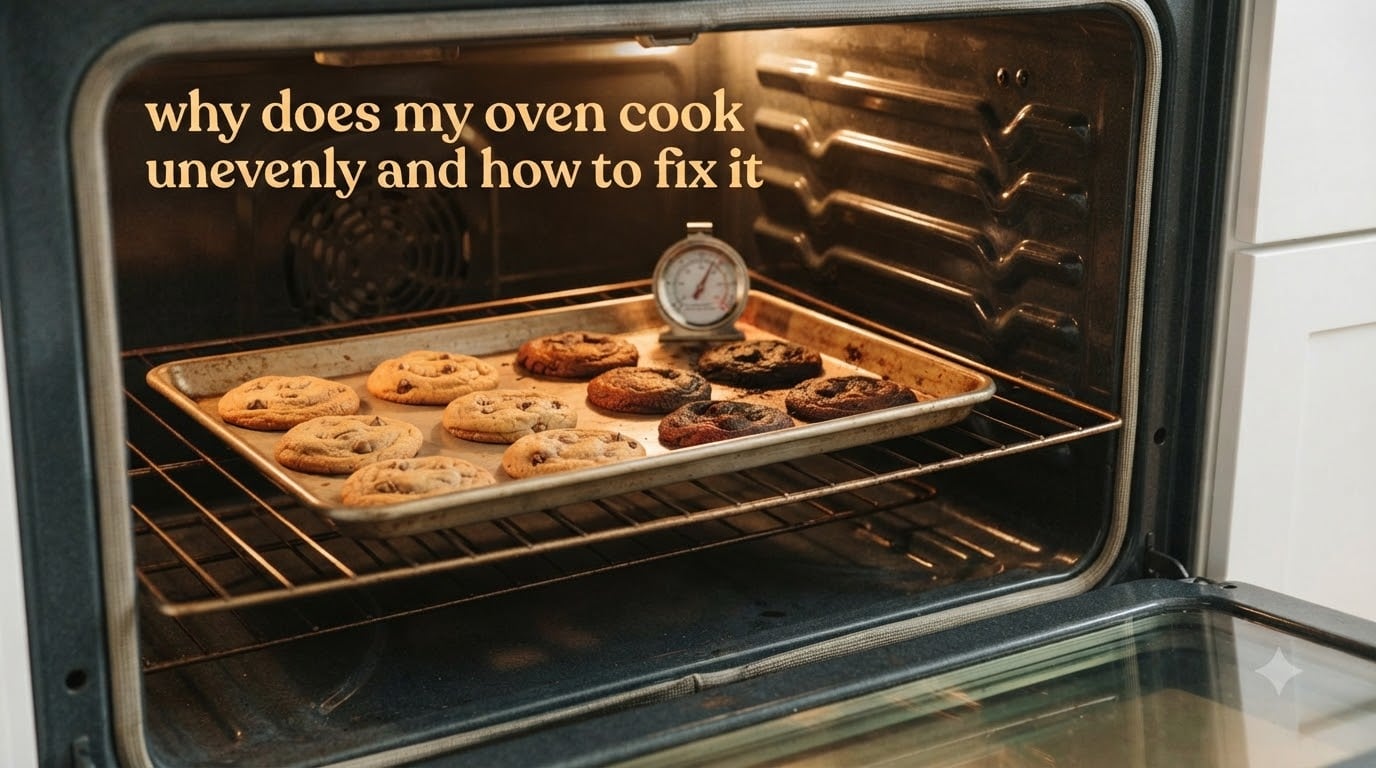
If your cookies burn on one side, your cake sinks in the middle, or your roast chars at the back of the oven, you are not alone. Uneven oven heat is the single most common baking complaint I hear from home cooks, and it shows up even in brand-new ovens. The good news: most of the time, the fix takes ten minutes and a basic ten-dollar oven thermometer, not a service call.
This guide walks you through how to confirm your oven really is cooking unevenly, the seven most common causes, and seven fixes you can try tonight before dinner. I will also show you when the problem actually points to a failing part, and when swapping to a different pan is all you need.
Table of Contents
Quick Answer: Why Your Oven Cooks Unevenly
An oven cooks unevenly when heat inside the cavity is not distributed equally, leaving hot spots and cold spots that brown, rise, or cook food at different rates depending on where it sits. The three biggest culprits are an inaccurate thermostat (your oven reads 350 but the cavity is 325), a worn door gasket that leaks heat, and bakeware that absorbs or blocks heat unevenly. A simple oven-thermometer test usually pinpoints which one is your problem in under 30 minutes.
Key takeaways:
- An inexpensive oven thermometer is the single best diagnostic tool you can buy.
- Most ovens drift 10 to 25 degrees off the set temperature, and some drift 50.
- Rotating pans halfway through baking fixes most uneven browning without any service work.
- Convection mode evens out heat but needs a 25 degree temperature reduction to avoid burning the outside.
- Brand-new ovens can cook unevenly too; a fresh seal, calibration, or rack change often solves it.
3 At-Home Tests to Diagnose Uneven Oven Heat
Before you blame the oven, confirm that the oven is actually the problem. These three tests take less than an hour total and tell you whether you have a real hot spot, a calibration drift, or a user-habit issue.
Test 1: The Oven Thermometer Test (most reliable)
Place a separate oven thermometer on the center rack, set the oven to 350 F, and let it preheat for a full 20 to 30 minutes. Read the thermometer every five minutes for the next 30 minutes. A healthy oven should hold within 10 degrees of the set temperature; a drifting oven will swing 15 to 25 degrees above or below the target. Many home bakers in cooking forums report discovering their oven reads 325 when set to 350, a 25 degree shortfall that explains every failed cookie sheet.
For a true hot-spot map, place three thermometers: left side, center, right side. A spread of more than 15 degrees across the rack tells you your oven has uneven heat distribution, not just calibration drift.
Test 2: The Bread Test
Slice a loaf of soft white bread into nine squares and arrange them across a parchment-lined sheet, covering every zone of the oven rack. Bake at 350 for 10 minutes. The squares that brown first mark your hot spots; the squares that stay pale mark cold zones. This is the test most recommended by home-baking communities because it doubles as a visual map you can photograph and compare after every fix.
Test 3: The Flour Test
Spread a thin, even layer of flour across a sheet of parchment paper on the center rack. Preheat to 350 and bake for 15 minutes. The flour darkens first over your hottest zones. Lift the parchment and hold it up to a window; the pattern is unmistakable. This is the fastest test if you do not want to wait for bread or worry about burning a snack.
7 Common Causes of Uneven Oven Cooking
If your diagnostic tests show real hot spots or temperature drift, the cause is almost always one of these seven. I have ordered them from most to least common in the home-kitchen complaints I see.
- Inaccurate temperature calibration. The thermostat reads one temperature while the cavity is another. This is the number one reason cookies burn and cakes sink. Many ovens drift 10 to 25 degrees within five years of manufacture.
- Worn or damaged door gasket. Heat escapes around a torn or stiff seal, and the side nearest the leak runs cooler. The fix is an inexpensive replacement gasket and ten minutes with a screwdriver.
- Faulty bake or broil element. A bake element that has blistered, broken, or developed a cold spot radiates unevenly. The fix is part replacement, not the oven.
- Poor airflow from overcrowding. Two sheet pans touching, or a casserole pushed against the back wall, blocks the convection path. Air has nowhere to move, so heat pools.
- Wrong rack position. Most ovens run hottest near the top and back where the elements sit. The center rack is the most even zone for nearly everything.
- Dark or heavy bakeware. Dark pans absorb more radiant heat than light aluminum and over-brown on the bottom and edges. Glass and cast iron hold heat longer and can scorch what touches them.
- Blocked or failed convection fan. If your convection oven cooks unevenly, the fan blade may be stuck, wobbly, or coated in grease. Convection mode only evens heat when the fan actually spins.
How to Fix an Uneven Oven: 7 Step-by-Step Fixes
Work through these fixes in order. The first three solve the majority of cases without tools. The last four address the parts and habits that need a closer look.
Step 1: Rotate Pans Halfway Through Baking
Turn your sheet pan 180 degrees at the halfway mark of every bake. For taller items like layer cakes, rotate the pan front-to-back instead so the same side does not always face the rear element. This single habit fixes uneven browning in most home ovens without changing anything else.
Step 2: Use the Center Rack for Almost Everything
The center rack sits in the largest air gap between the bake and broil elements, which gives heat the most even path around your food. Use the lower third only for pizza and bread when you want a crisper bottom; use the upper third only for browning the top of a casserole or finishing a meringue.
Step 3: Preheat for a Full 20 to 30 Minutes
Most ovens beep when they hit the target temperature, but the cavity and walls are still warming up. A 20 to 30 minute preheat lets the air, racks, and walls reach a real equilibrium. Many gas oven owners in particular find that a longer preheat eliminates the back-of-oven hot spot almost entirely.
Step 4: Calibrate Your Oven Thermostat
Many digital ovens let you adjust the displayed temperature up or down by 5 to 35 degrees. Check your model manual for the calibration sequence (usually a hidden button combo or a settings menu). Set the offset to match the drift you measured in Test 1. This single change rescued more frustrated bakers than any other fix in the forums I read.
Step 5: Replace the Door Gasket
Close the door on a sheet of paper and try to pull it out. If it slides easily anywhere along the seal, the gasket has lost tension and is leaking heat. Replacement gaskets are inexpensive, model-specific, and install in under ten minutes with a screwdriver. This is also the single fix several forum users credited with restoring even browning after years of frustration.
Step 6: Switch to Light Aluminum Bakeware
If you bake mostly in dark nonstick or heavy glass pans, try a single batch in light-colored aluminum. Several home bakers reported that this switch alone solved their uneven cooking without touching the oven. Light aluminum reflects heat; dark pans absorb it. For cookies and most cakes, light aluminum wins. Save glass for pies and custards where you want gentle, even heat retention.
Step 7: Switch to Convection Mode and Convert the Temperature
Convection mode (a fan at the back) is specifically designed to even out oven heat. The catch: most recipes need a 25 degree temperature reduction and a 20 percent shorter cook time, otherwise the outside burns before the inside cooks through. Use convection for cookies, sheet-pan vegetables, and roasts; skip it for delicate custards, souffles, and most quick breads.
Recipe-Specific Adjustments for Uneven Heat
Different foods tolerate uneven oven heat very differently. Matching the fix to the recipe class turns a guessing game into a reliable bake.
Cookies and Sheet-Pan Vegetables
These are the most forgiving and benefit the most from convection mode. Use the center rack, light aluminum pans, and rotate halfway. If cookies still brown unevenly, drop the temperature by 25 degrees and extend the bake by two minutes.
Cakes and Brownies
Layer cakes need gentle, even heat. Use the center rack, light aluminum pans, and avoid opening the oven door for the first two-thirds of the bake. A cake that sinks in the middle usually points to a 25+ degree temperature shortfall, not a recipe problem. Add a baking stone on the lower rack to even out radiant heat if your oven runs hot at the bottom.
Bread and Pizza
Bread and pizza want strong bottom heat to crisp the crust. Place a baking steel or stone on the lower rack and preheat it for a full 45 minutes. Slide the dough directly onto the preheated surface. This single change is what separates uneven home bread from bakery-quality crust.
Roasts and Casseroles
Use the lower-middle rack for whole roasts so the convection path can circulate around them. If your oven runs hot at the back (a common gas-oven quirk), turn the roasting pan 180 degrees at the halfway mark. Shield the wing tips or bone ends with foil if they brown too fast.
Gas vs Electric vs Convection: Why Your Oven Type Matters
Each oven type has a personality. Knowing yours explains a lot about why some recipes work and others fail.
| Oven Type | Typical Hot Spot | Best Fix |
|---|---|---|
| Gas (conventional) | Back and top run hottest | Rotate pans, lower rack, longer preheat |
| Electric (conventional) | Bottom rack browns fastest | Use center rack, switch to light aluminum |
| Convection | Even if fan works; uneven if fan is sluggish | Reduce temp by 25 F, shorten cook time 20 percent |
| Wall oven | Front edge runs cooler | Pull pans 1 inch back from the door |
Gas oven owners in particular report the back of the oven running noticeably hotter than the front; electric owners report more bottom-rack burn-out. Convection ovens are the most even overall, but only when the fan is clean and spinning at full speed.
When to Call a Professional About Uneven Oven Heat
Most uneven cooking is a calibration, gasket, or habit problem. But sometimes it is a real equipment failure. Call a service technician if you notice any of the following.
- The bake element has a visible blister, break, or cold spot.
- The oven will not hold temperature at all and drifts more than 50 degrees in either direction.
- The convection fan is loud, wobbly, or does not spin.
- The temperature sensor wire is visibly damaged or the reading jumps randomly.
- You smell gas, see scorch marks around the door, or the oven trips the breaker.
- Calibration, gasket replacement, and bakeware changes have not improved results after two weeks of testing.
A typical service call for diagnosis and parts runs about the price of a nice dinner out. For an oven older than ten years, weigh that against replacement; a new budget oven often costs less than two major repairs.
Prevention Tips: Keeping Even Heat Long-Term
A few habits keep your oven cooking evenly for years after the initial fix.
- Wipe the door gasket monthly with a damp cloth; built-up grease cracks the rubber.
- Run the self-clean cycle once a quarter to clear the convection fan and element covers.
- Re-check calibration annually with an oven thermometer; thermostats drift over time.
- Replace the gasket every five to seven years as preventive maintenance.
- Avoid lining the oven floor with foil; it reflects heat back into the bake element and shortens its life.
Frequently Asked Questions
Why does my oven cook so unevenly?
Most ovens cook unevenly because the thermostat drifts away from the set temperature, the door gasket leaks heat, or the bake element is failing. An inexpensive oven thermometer left on the center rack during a 350 F preheat usually pinpoints the cause in under 30 minutes.
Why does my oven not cook things in the middle?
When food stays raw in the middle but burns on the edges, the oven is running 25 to 50 degrees cooler than the display. The thermostat thinks it has reached the target and shuts off the element before the cavity actually does. Calibrating the thermostat or replacing the temperature sensor fixes this in most ovens.
How do I fix an uneven oven?
Work through these steps in order: rotate pans halfway through baking, use the center rack, preheat for 20 to 30 minutes, calibrate the thermostat, replace the door gasket if it has lost tension, switch to light aluminum bakeware, and try convection mode with a 25 degree temperature reduction.
What type of oven distributes heat unevenly?
Conventional gas and electric ovens distribute heat least evenly because heat rises from a single element at the bottom and another at the top. Convection ovens are the most even when the fan is clean and spinning at full speed. Wall ovens often run cooler at the front edge because of door-heat loss.
How can I tell if my oven temperature is off?
Place an oven thermometer on the center rack, set the oven to 350 F, and preheat for 20 to 30 minutes. Read the thermometer every five minutes for the next 30 minutes. If it holds within 10 degrees of the set temperature the oven is fine; a swing of more than 15 degrees means the thermostat needs calibration.
Can the type of baking pan really affect how my food cooks?
Yes. Dark nonstick pans absorb more radiant heat than light aluminum and brown the bottom and edges faster. Glass and cast iron retain heat longer and can scorch food that touches them. Switching to light aluminum pans solves uneven cooking for many home bakers without touching the oven itself.
Does overcrowding the oven really cause uneven cooking?
Yes. Sheet pans that touch each other or sit against the back wall block the convection path. Heat has nowhere to move, so it pools around one pan while leaving another cold. Leave at least 1 inch of space between pans and 2 inches of space around all sides of the rack.
How important is preheating the oven?
Preheating is critical. Most ovens beep when the air temperature hits the target, but the walls, racks, and bakeware are still warming up. A 20 to 30 minute preheat lets the entire cavity reach a real equilibrium and is the difference between even browning and hot spots.
Is it really necessary to rotate pans during cooking?
Yes for most home ovens. Rotating a sheet pan 180 degrees halfway through baking compensates for the back-of-oven hot spot almost every conventional oven has. It takes three seconds and is the single cheapest fix for uneven browning.
What happens if I open the oven door too often while cooking?
Each door opening drops the cavity temperature by 25 to 50 degrees and the oven has to reheat from scratch. For long bakes like roasts and bread this matters less, but for cookies, cakes, and souffles it is enough to cause sinking or uneven rise. Wait until the visual cue you need is clearly visible before opening the door.
Can uneven cooking be caused by my oven design?
Yes. Conventional ovens have a single bake element at the bottom and a single broil element at the top, so heat rises unevenly. The back of the oven near the convection fan or rear wall typically runs hottest. Convection mode was specifically designed to even out this design-driven hot spot.
Final Thoughts: Why Your Oven Cooks Unevenly and What to Do Next
So why does your oven cook unevenly? In most cases it is a thermostat that has drifted, a gasket that no longer seals, or a habit that fights the oven’s natural hot spots. None of those require a service call, and most are fixable tonight.
Start with the oven thermometer test. If it shows more than a 15 degree drift, calibrate the thermostat. If your gasket has lost tension, replace it. From then on, use the center rack, preheat for a full 20 to 30 minutes, rotate your pans halfway, and bake in light aluminum pans. Those four habits solve about 80 percent of uneven oven cooking in my experience.
If you have worked through all seven fixes and still get hot spots, it is time to call a technician. A failing bake element, a stuck convection fan, or a bad temperature sensor are the most likely culprits, and all three are cheaper to fix than to replace the oven.