
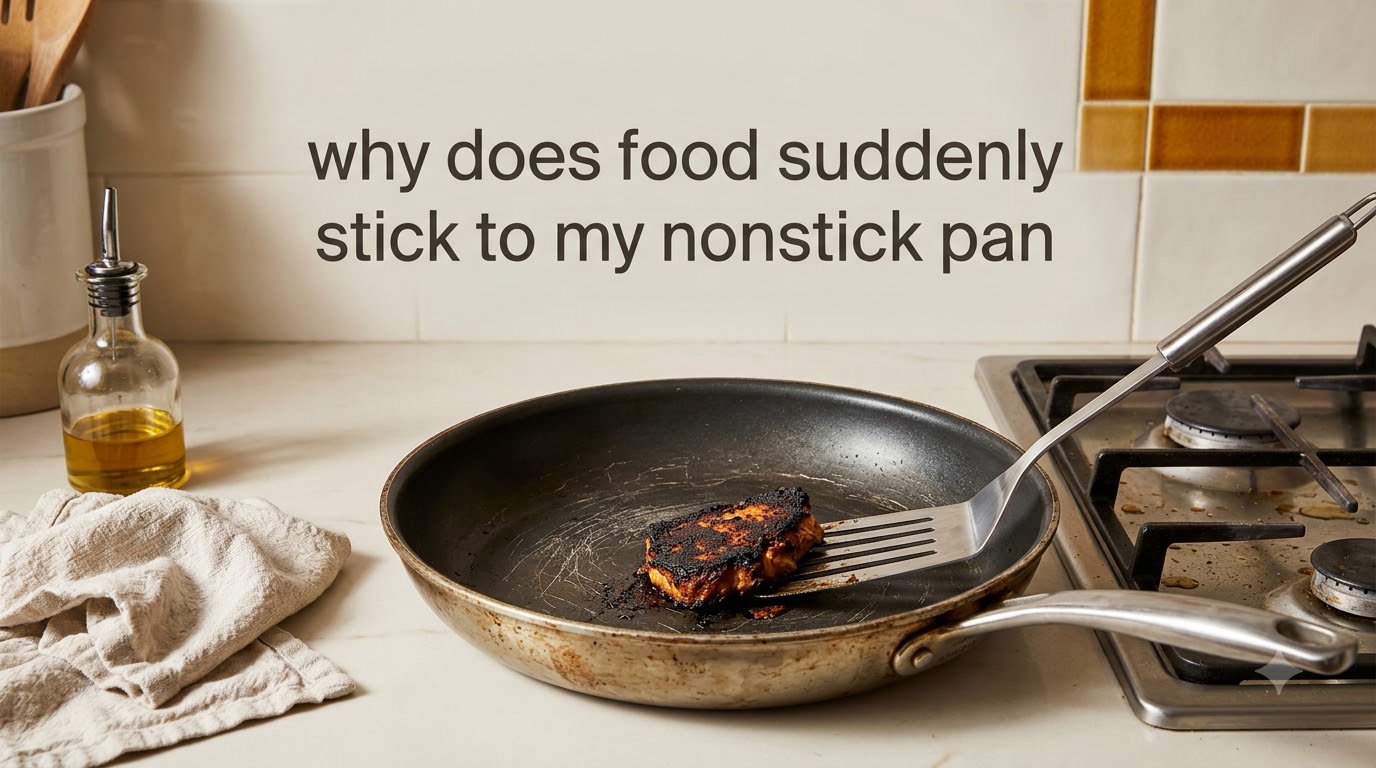
If you’ve asked yourself, “why does food suddenly stick to my nonstick pan,” you’re not alone. We hear this frustration from home cooks every week. A pan that slid eggs perfectly last month now welds them to the surface. The good news: sudden sticking almost always has a specific, fixable cause.
Key Takeaways
- Sudden sticking is usually caused by residue buildup, scratches, or high-heat damage, not a “bad” pan.
- Cooking sprays are the most common hidden culprit because they polymerize into a sticky film.
- The water-drop preheating test fixes more sticking issues than any other single tip.
- Most nonstick pans can be restored; replace when the coating is flaking or pan-warped.
Table of Contents
Why Does Food Suddenly Stick to My Nonstick Pan? 8 Common Causes
Nonstick pans don’t lose their coating overnight, but they do shift from “perfectly slick” to “everything glues itself to the surface” surprisingly fast. From our testing, one small change in routine is usually enough to flip the switch. Here are the eight causes we see most often, in the order they typically appear.
1. Scratches on the nonstick coating
A single scratch exposes the bare aluminum underneath, and bare aluminum grabs onto food proteins like glue. Metal spatulas, steel wool, stacking pans without a liner, and even aggressive dishwasher cycles create these micro-scratches invisibly. Once the coating is broken in one spot, sticking starts there and spreads.
Forum signal: cooks on r/cookware and r/AskCulinary regularly report pans “suddenly” sticking after just a few months, almost always traced back to one metal utensil or a single dishwasher run.
2. Cooking spray residue buildup
Aerosol cooking sprays contain lecithin and dimethyl silicone, which polymerize (harden) on a hot nonstick surface into a brown, sticky lacquer. Each pass adds another micro-layer. After 20 to 30 uses, the “seasoning” you’ve accidentally built is thicker than the factory coating underneath, and nothing slides anymore. This is the single most common cause of sudden sticking in our experience.
3. Burnt-on food and carbonized oil
When oil or food overheats, it carbonizes into a rough, matte film that feels smooth but acts like sandpaper. This layer bonds so tightly to the coating that even hand-washing won’t remove it. We see this most often after searing at high heat or leaving an empty pan on a hot burner.
4. Degraded coating from high heat
PTFE coatings start to break down around 500°F (260°C); ceramic sol-gel coatings are more heat-tolerant but still degrade over time. If your pan regularly smokes on the stovetop, the coating is slowly losing its nonstick properties. You’ll notice eggs release fine one week and start tearing the next.
5. Old age and natural coating breakdown
Most nonstick pans last 2 to 5 years with daily use, less with heavy use. The coating doesn’t visibly “wear out” in one dramatic moment. Instead, it gradually loses hydrophobicity (water-shedding ability). One day you realize you need more oil than you used to. That moment is the coating telling you it’s tired.
6. The pan wasn’t properly preheated
Adding cold food to a cold pan is the number-one technique mistake. The food bonds to the surface before the oil spreads evenly. We see this in r/Cooking threads constantly: “the pan was fine yesterday, now eggs stick.” Almost always, the cook skipped the preheat step or rushed it.
7. Too little or too much oil
Both extremes cause sticking. Too little oil leaves dry spots where proteins bond directly to the metal. Too much oil pools in the pan’s center, leaving the outer ring bone-dry. The right amount is enough to coat the entire surface thinly, about 1 to 2 teaspoons for a 10-inch pan.
8. Pan warp causing uneven contact
If a pan warps (common after a dishwasher cycle or thermal shock, like a hot pan rinsed in cold water), only the warped-up center touches the burner. Food in that center overheats while food at the edges stays cool and sticks. A warped pan cannot be fixed and should be replaced.
The Science Behind Sticking: Thermocapillary Convection Explained
Here’s the part most articles skip, and it’s why even “perfect” nonstick pans sometimes stick. A 2021 study in Physics of Fluids showed that even on a flawless Teflon surface, food can still weld itself to the pan. The reason is called thermocapillary convection.
When you heat a pan, the oil film develops tiny temperature gradients, hotter in the center, cooler at the edges. Surface tension changes with temperature, so the oil actually flows away from the hot spots. The result: dry patches form in the middle of the pan, even though there’s oil everywhere else. Food that lands on a dry patch sticks, no matter how good your coating is.
The fix is straightforward: keep the heat uniform and use enough oil to prevent the dry patches from forming. This is also why a heavy-bottomed pan outperforms a thin one. Thicker bottoms distribute heat more evenly, so fewer dry patches develop. Food & Wine’s reporting on this study was the first to make the concept accessible to home cooks, and we still reference it.
How to Fix a Nonstick Pan That Sticks (And When to Replace It)
Once you know the cause, the fix usually takes under 30 minutes. We’ll walk you through the methods that actually work, then show you the five signs that mean it’s time to replace, not restore.
Baking soda paste deep-clean method
Mix 2 tablespoons of baking soda with 1 tablespoon of water to form a paste. Spread it over the pan’s surface, let it sit for 15 minutes, then scrub gently with a soft sponge in circular motions. This lifts polymerized spray residue and carbonized oil without scratching the coating. Rinse, dry, and re-test with an egg.
Vinegar soak for hard water and grease
For white, chalky buildup (hard water minerals) or light grease film, fill the pan with equal parts white vinegar and water. Bring it to a simmer for 5 minutes, let it cool, then wash normally. The acid dissolves minerals that hand soap can’t touch.
The water-drop preheating test
This is the single most useful trick we teach. Heat the dry pan over medium heat for 2 minutes. Flick a few drops of water onto the surface. If they bead up and dance around the pan like mercury, the pan is at the right temperature (~325°F). If they evaporate instantly, the pan is too hot. If they sit and steam, it’s too cold. Add oil only after the droplets dance. This test alone eliminates most sticking from rushed preheating.
Re-seasoning a ceramic pan
Ceramic pans benefit from a light re-seasoning. Wash and dry the pan, then wipe a thin layer of neutral oil (grapeseed or avocado) across the surface. Heat on medium for 2 minutes, let cool, and wipe out excess. This restores some slickness, though it won’t repair a truly degraded coating.
When to replace: 5 clear signs
Stop restoring and start shopping when you see these:
- Visible flaking of the coating, even small chips, into your food.
- Deep scratches you can feel with a fingernail across the surface.
- Discoloration that won’t scrub off, especially dark brown or black patches.
- Pan warp (rocking on a flat countertop) that won’t go away.
- Sticking returns within one or two uses of any cleaning method.
If two or more of these apply, your pan has reached the end of its useful life. Continuing to cook on a flaking nonstick surface is a health concern (ingested coating fragments) and the food will keep sticking no matter what you do.
How to Prevent Sticking: Nonstick Pan Care Tips
Prevention is easier than restoration. These five habits will keep a new pan slick for years.
Use medium heat, always
Nonstick coatings are designed for low-to-medium cooking. Reserve high heat for cast iron and carbon steel. If your pan smokes at the heat setting you’re using, turn it down.
Skip the aerosol cooking sprays
Use a refillable oil mister or pour oil from a bottle. Aerosol sprays build up the polymerized residue we covered earlier, even on premium pans.
Choose the right utensils
Wood, silicone, or nylon only. No metal. Ever. This single habit extends nonstick life by 2 to 3 years in our experience.
Hand wash, don’t dishwash
Dishwasher detergent is abrasive, and the high-heat drying cycle accelerates coating breakdown. A 60-second hand wash with mild dish soap extends pan life noticeably.
Store with a liner
Stack pans with a paper towel, cloth napkin, or pan protector between them. Scratches from stacking are invisible until they aren’t.
Frequently Asked Questions
Why is my nonstick pan suddenly sticking?
Sudden sticking is almost always caused by residue buildup (especially from cooking sprays), new scratches exposing bare metal, or the coating reaching the end of its life. A baking soda paste deep-clean solves the first two; replacement is the answer for the third.
How to stop food sticking to a non-stick pan?
Preheat the pan over medium heat for 2 minutes, run the water-drop test (drops should dance like mercury), then add enough oil to coat the entire surface. Use medium heat, wooden or silicone utensils, and skip aerosol cooking sprays.
Why does my food stick to my pan even though I use oil?
Usually the oil is uneven (too little, pooled in the center, or not preheated enough) or there’s a residue layer on top of the coating preventing contact. Try the baking soda deep-clean, then test with the water-drop method before your next cook.
Why is everything suddenly sticking to my pan?
When every food starts sticking at once, the cause is usually coating-wide, not technique: polymerized spray residue, a degraded coating from years of high heat, or pan warp. Deep-clean first; if sticking returns within one or two uses, replace the pan.
Why Does Food Suddenly Stick to My Nonstick Pan? Final Thoughts
Now you understand why food suddenly sticks to your nonstick pan and, more importantly, how to fix it. Start with the easiest solutions: skip the cooking spray, preheat properly with the water-drop test, and use medium heat. If sticking persists, run the baking soda deep-clean. If it returns within a couple of uses, the coating is done, and it’s time for a new pan.
Most nonstick pans are designed to make cooking easier, not last forever. Treat them gently, and they’ll reward you with years of effortless eggs and fish. When they finally give out, you’ll recognize the signs and replace with confidence rather than frustration.